Home » Customization (Page 9)
Category Archives: Customization
Expand Tokens on Sitecore Items Using a Custom Command in Sitecore PowerShell Extensions
During my Sitecore from the Command Line presentation at the Sitecore User Group – New England, I had shown attendees how they could go about adding a custom command into the Sitecore PowerShell Extensions module.
This blog post shows what I had presented — although the code in this post is an improved version over what I had presented at my talk. Many thanks to Sitecore MVP Adam Najmanowicz for helping me make this code better!
The following command will expand “out of the box” tokens in all fields of a supplied Sitecore item — check out Expand Tokens on Sitecore Items Using a Custom Command in Revolver where I discuss the problem commands like this address, and this article by Sitecore MVP Jens Mikkelsen which lists “out of the box” tokens available in Sitecore:
using System;
using System.Management.Automation;

using Sitecore.Configuration;

using Sitecore.Data;
using Sitecore.Data.Items;

using Cognifide.PowerShell.PowerShellIntegrations.Commandlets;

namespace CommandLineExtensions.PowerShell.Commandlets
{
    [Cmdlet("Expand", "Token")]
    [OutputType(new[] { typeof(Item) })]
    public class ExpandTokenCommand : BaseCommand
    {
        private static readonly MasterVariablesReplacer TokenReplacer = Factory.GetMasterVariablesReplacer();

        [Parameter(Position = 0, Mandatory = true, ValueFromPipeline = true)]
        public Item Item { get; set; }

        protected override void ProcessRecord()
        {
            Item.Editing.BeginEdit();
            try
            {
                TokenReplacer.ReplaceItem(Item);
                Item.Editing.EndEdit();
            }
            catch (Exception ex)
            {
                Item.Editing.CancelEdit();
                throw ex;
            }

            WriteItem(Item);
        }
    }
}
The command above subclasses Cognifide.PowerShell.PowerShellIntegrations.Commandlets.BaseCommand — the base class for most (if not all) commands in Sitecore PowerShell Extensions.
An item is passed to the command via a parameter, and is magically set on the Item property of the command class instance.
The ValueFromPipeline parameter being set to “true” on the Item property’s Parameter attribute will allow for chaining of this command with others so that items can be fed into it via a pipe bridging the commands together in PowerShell.
An instance of the Sitecore.Data.MasterVariablesReplacer class — which is created by the GetMasterVariablesReplacer() method of the Sitecore.Configuration.Factory class based on the “MasterVariablesReplacer” setting of your Sitecore instance’s Web.config — is used to expand tokens on the supplied Sitecore item after the item was flagged for editing.
Once tokens have been expanded on the item — or not in the event an exception is encountered — the item is written to the Results window via the WriteItem method which is defined in the BaseCommand class.
I then had to wire up the custom command via a patch configuration file:
<configuration xmlns:patch="http://www.sitecore.net/xmlconfig/">
  <sitecore>
    <powershell>
      <commandlets>
		    <add Name="Custom Commandlets" type="*, CommandLineExtensions" />
      </commandlets>
    </powershell>
  </sitecore>
</configuration>
Let’s take this custom command for a spin.
I created a bunch of test items, and set tokens in their fields. I then selected the following page at random for testing:

I opened up the Integrated Scripting Environment of Sitecore PowerShell Extensions, typed in the following PowerShell code, and executed by pressing Ctrl-E:

As you can see tokens were expanded on the Page One item:

How about expanding tokens on all descendants of the Home item? Let’s see an example of how we can do that.
I chose the following content item — a grandchild of the Home item — for testing:

I switched back over to the Integrated Scripting Environment, wrote the following code for testing — the Get-ChildItem command with the -r parameter (this means do this recursively) will grab all descendants of the Home item, and pipe each item in the result set into the Expand-Token command — and clicked the Execute button:

I then went back to the grandchild item of the Home page in the content tree, and saw that tokens were expanded in its fields:

If you have any thoughts or comments on this, or ideas for new commands in Sitecore PowerShell Extensions, please share in a comment.
Until next time, have a scriptolicious day!
Expand Tokens on Sitecore Items Using a Custom Command in Revolver
On September 18, 2013, I presented Sitecore from the Command Line at the Sitecore User Group – New England.
During my presentation, I gave an example of creating a custom command in Revolver — the first scripting platform for Sitecore built by Alistair Deneys — and thought I would write something up for those who had missed the presentation, or wanted to revisit what I had shown.
One thing that plagues some Sitecore developers — if you disagree please leave a comment — is not having a nice way to expand tokens on items when tokens are added to Standard Values after items had been created previously.
Newly added tokens “bleed” into preexisting items’ fields, and I’ve seen developers perform crazy feats of acrobatic gymnastics to expand them — writing a standalone web form to recursive crawl the content tree to expand these is such an example (take a look at Empower Your Content Authors to Expand Standard Values Tokens in the Sitecore Client where I offer an alternative way to expand tokens on content items).
The following custom Revolver command will expand tokens on a supplied Sitecore item, and help out on the front of expanding newly added tokens on preexisting items:
using System;
using Sitecore.Configuration;
using System.Linq;

using Sitecore.Data;
using Sitecore.Data.Items;

using Revolver.Core;
using Revolver.Core.Commands;

namespace CommandLineExtensions.Revolver.Commands
{
    public class ExpandTokensCommand : BaseCommand
    {
        private static readonly MasterVariablesReplacer TokenReplacer = Factory.GetMasterVariablesReplacer();

        public override string Description()
        {
            return "Expand tokens on an item";
        }

        public override HelpDetails Help()
        {
            HelpDetails details = new HelpDetails
            {
                Description = Description(),
                Usage = "<cmd> [path]"
            };

            details.AddExample("<cmd>");
            details.AddExample("<cmd> /item1/item2");
            return details;
        }

        public override CommandResult Run(string[] args)
        {
            string path = string.Empty;
            if (args.Any())
            {
                path = args.FirstOrDefault();
            }

            using (new ContextSwitcher(Context, path))
            {
                if (!Context.LastGoodPath.EndsWith(path, StringComparison.CurrentCultureIgnoreCase))
                {
                    return new CommandResult
                    (
                        CommandStatus.Failure,
                        string.Format("Failed to expand tokens on item {0}\nReason:\n\n An item does not exist at that location!", path)
                    );
                }

                CommandResult result;
                Item item = Context.CurrentItem;
                item.Editing.BeginEdit();
                try
                {
                    TokenReplacer.ReplaceItem(item);
                    result = new CommandResult(CommandStatus.Success, string.Concat("Expanded tokens on item ", Context.LastGoodPath));
                    item.Editing.EndEdit();
                }
                catch (Exception ex)
                {
                    item.Editing.CancelEdit();
                    result = new CommandResult(CommandStatus.Failure, string.Format("Failed to expand tokens on item {0}\nReason:\n\n{1}", path, ex));
                }

                return result;
            }
        }
    }
}
Tokens are expanded using an instance of the Sitecore.Data.MasterVariablesReplacer class — you can roll your own, and wire it up in the “MasterVariablesReplacer” setting of your Sitecore instance’s Web.config — which is provided by Sitecore.Configuration.Factory.GetMasterVariablesReplacer().
All custom commands in Revolver must implement the Revolver.Core.ICommand interface. I subclassed Revolver.Core.Commands.BaseCommand — which does implement this interface — since it seemed like the right thing to do given that all “out of the box” commands I saw in Revolver were subclassing it, and then implemented the Description(), Help() and Run() abstract methods.
I then had to bind the custom command to a new name — I chose “et” for “Expand Tokens”:
@echooff
@stoponerror

bind CommandLineExtensions.Revolver.Commands.ExpandTokensCommand,CommandLineExtensions et

@echoon
Since it wouldn’t be efficient to type and run this bind script every time I want to use the “et” command, I added it into a startup script in the core database:

I then had to create a user script for the startup script to run. I chose the Everyone role here for demonstration purposes:

The above startup script will be invoked when Revolver is opened, and our custom command will be bound.
Let’s see all of the above in action.
I added some tokens in my home item:

I then opened up Revolver, navigated to /sitecore/content, and ran the custom command on the home item:

As you can see the tokens were expanded:

You might be thinking “that’s wonderful Mike — except now I have to navigate to every item in my content tree using Revolver, and then run this custom command on it”.
Well, I do have a solution for this: a custom script that grabs an item and all of its descendants using a Sitecore query, and passes them to the custom command to expand tokens:
@echooff
@stoponerror

if ($1$ = \$1\$) (exit (Missing required parameter path))

@echoon

query -ns $1$/descendant-or-self::* et
I put this script in the core database, and named it “etr” for “Expand Tokens Recursively”:
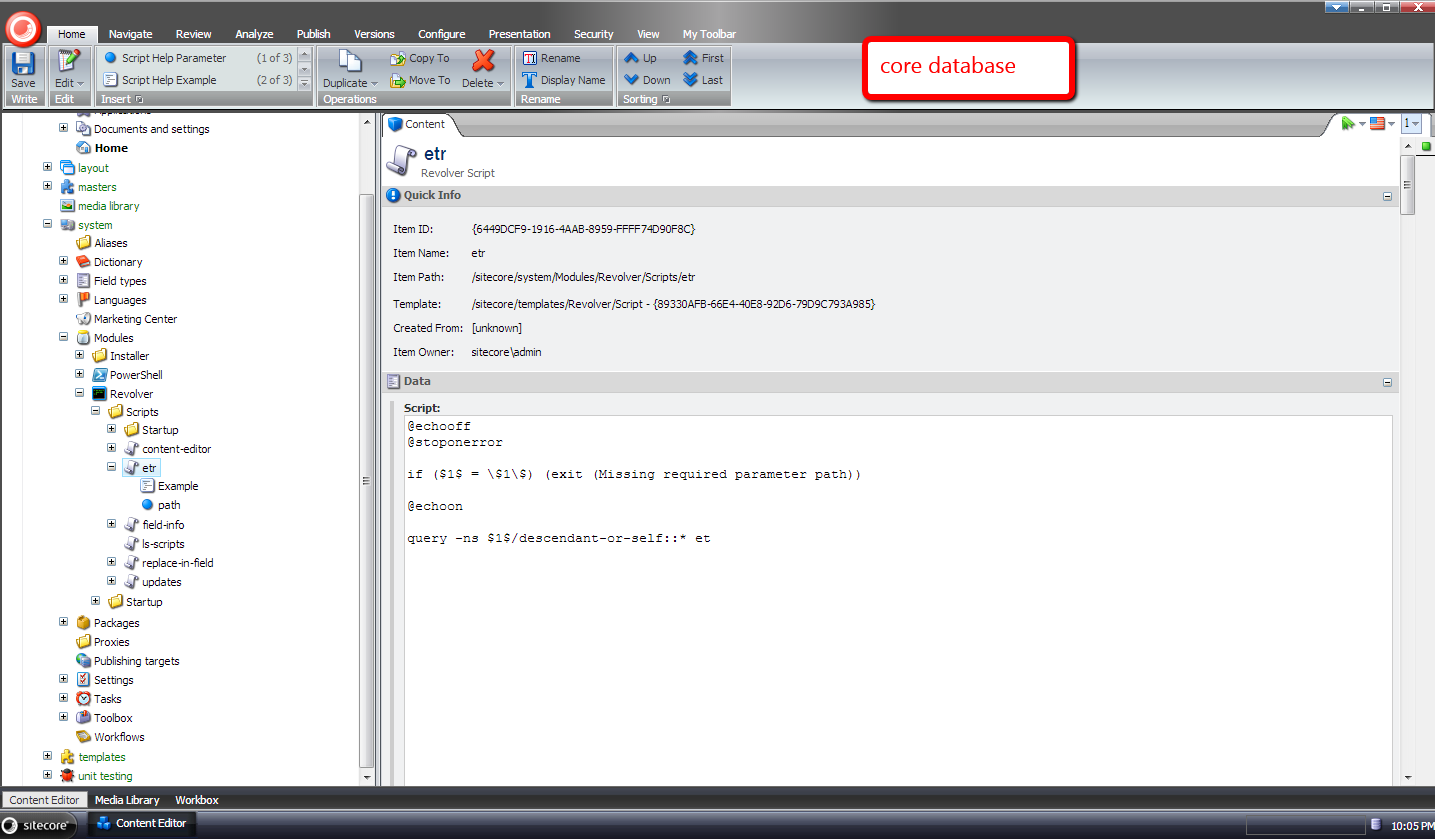
I navigated to a descendant of /sitecore/content/home, and see that it has some unexpanded tokens on it:

I went back to Revolver, and ran the “etr” command on the home item:

As you can see tokens were expanded on the descendant item:
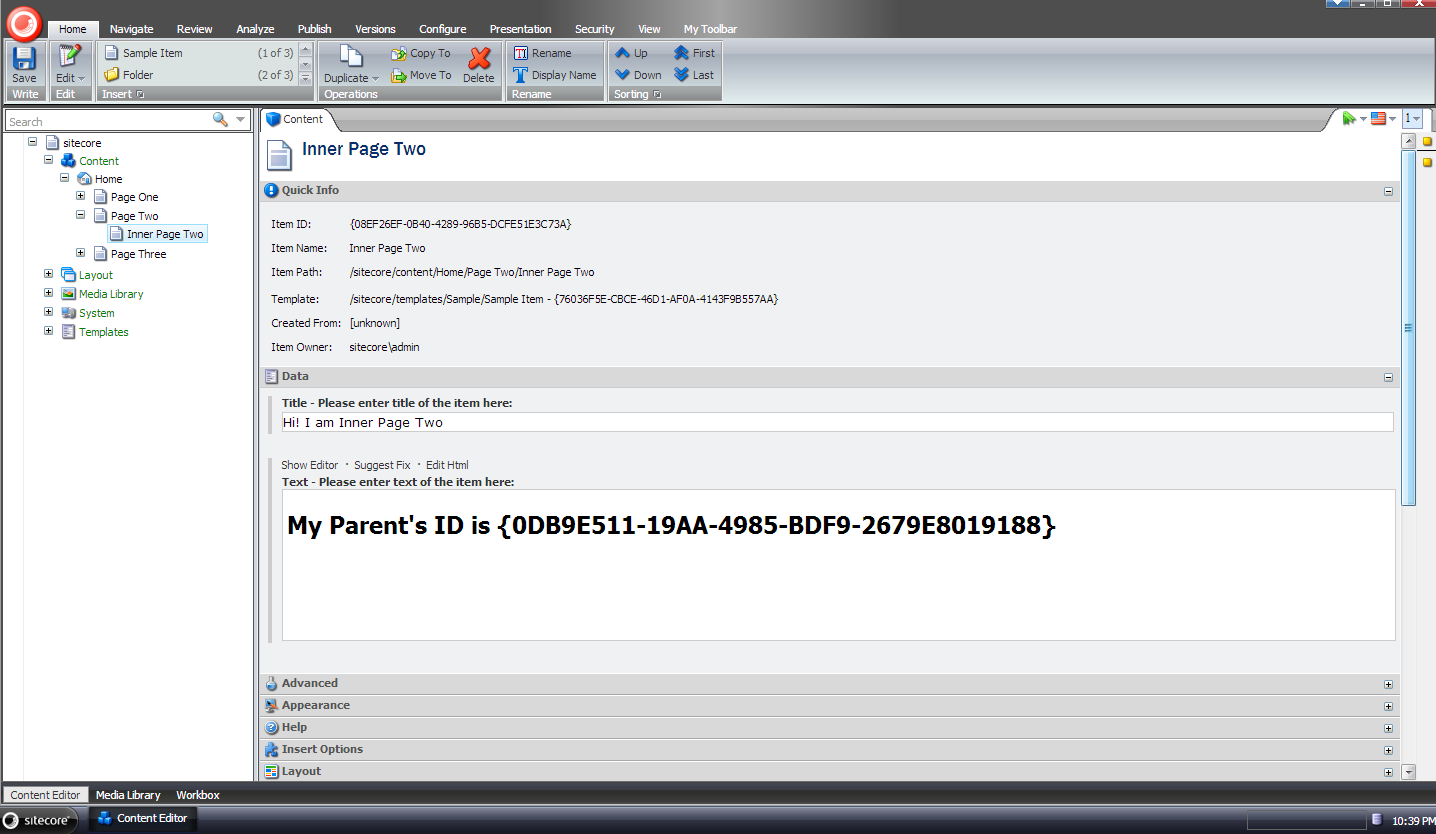
If you have any thoughts on this, or have ideas for other custom commands in Revolver, please share in a comment.
Shortcodes in Sitecore: A Proof of Concept
Today I stumbled upon a post in one of the SDN forums asking whether anyone had ever implemented shortcodes in Sitecore.
I have not seen an implementation of this for Sitecore — if you know of one, please drop a comment — but am quite familiar with these in WordPress — I use them to format code in my blog posts using the [code language=”csharp”]//code goes in here[/code] shortcode — and felt I should take on the challenge of implementing a “proof of concept” for this in Sitecore.
I first created a POCO that will hold shortcode data: the shortcode itself and the content (or markup) that the shortcode represents after being expanded:
namespace Sitecore.Sandbox.Pipelines.ExpandShortcodes
{
    public class Shortcode
    {
        public string Unexpanded { get; set; }

        public string Expanded { get; set; }
    }
}
I thought it would be best to put the logic that expands shortcodes into a new pipeline, and defined a pipeline arguments class for it:
using Sitecore.Pipelines;

namespace Sitecore.Sandbox.Pipelines.ExpandShortcodes
{
    public class ExpandShortcodesArgs : PipelineArgs
    {
        public string Content { get; set; }
    }
}
There really isn’t much to this arguments class — we will only be passing around a string of content that will contain shortcodes to be expanded.
Before moving forward on building pipeline processors for the new pipeline, I saw that I could leverage the template method pattern to help me process collections of Shortcode instances in an abstract base class:
using System.Collections.Generic;
using System.Linq;
using System.Text.RegularExpressions;

using Sitecore.Diagnostics;

namespace Sitecore.Sandbox.Pipelines.ExpandShortcodes
{
    public abstract class ExpandShortcodesProcessor
    {
        public virtual void Process(ExpandShortcodesArgs args)
        {
            if (string.IsNullOrWhiteSpace(args.Content))
            {
                return;
            }

            IEnumerable<Shortcode> shortcodes = GetShortcodes(args.Content);
            if (shortcodes == null || !shortcodes.Any())
            {
                return;
            }

            args.Content = ExpandShortcodes(shortcodes, args.Content);
        }

        protected abstract IEnumerable<Shortcode> GetShortcodes(string content);

        protected virtual string ExpandShortcodes(IEnumerable<Shortcode> shortcodes, string content)
        {
            Assert.ArgumentNotNull(shortcodes, "shortcodes");
            Assert.ArgumentNotNull(content, "content");
            string contentExpanded = content;
            foreach (Shortcode shortcode in shortcodes)
            {
                contentExpanded = contentExpanded.Replace(shortcode.Unexpanded, shortcode.Expanded);
            }

            return contentExpanded;
        }
    }
}
The above class iterates over all Shortcode instances, and replaces shortcodes with their expanded content.
Each subclass processor of ExpandShortcodesProcessor are to “fill in the blanks” of the algorithm defined in the base class by implementing the GetShortcodes method only — this is where the heavy lifting of grabbing the shortcodes from the passed string of content, and the expansion of these shortcodes are done. Both are then set in new Shortcode instances.
Once the base class was built, I developed an example ExpandShortcodesProcessor subclass to expand [BigBlueText]content goes in here[/BigBlueText] shortcodes (in case you’re wondering, I completely fabricated this shortcode — it does not exist in the real world):
using System.Collections.Generic;
using System.Text.RegularExpressions;

namespace Sitecore.Sandbox.Pipelines.ExpandShortcodes
{
    public class ExpandBigBlueTextShortcodes : ExpandShortcodesProcessor
    {
        protected override IEnumerable<Shortcode> GetShortcodes(string content)
        {
            if(string.IsNullOrWhiteSpace(content))
            {
                return new List<Shortcode>();
            }

            IList<Shortcode> shortcodes = new List<Shortcode>();
            MatchCollection matches = Regex.Matches(content, @"\[BigBlueText\](.*?)\[/BigBlueText\]", RegexOptions.IgnoreCase);

            foreach (Match match in matches)
            {
                string innerText = match.Groups[1].Value.Trim();
                if (!string.IsNullOrWhiteSpace(innerText))
                {
                    shortcodes.Add
                    (
                        new Shortcode
                        {
                            Unexpanded = match.Value,
                            Expanded = string.Format(@"<span style=""font-size:56px;color:blue;"">{0}</span>", innerText)
                        }
                    );
                }
            }

            return shortcodes;
        }
    }
}
I followed the above example processor with another — a new one to expand [YouTube id=”video id goes in here”] shortcodes (this one is made up as well, although YouTube shortcodes do exist out in the wild):
using System.Collections.Generic;
using System.Text.RegularExpressions;

namespace Sitecore.Sandbox.Pipelines.ExpandShortcodes
{
    public class ExpandYouTubeShortcodes : ExpandShortcodesProcessor
    {
        protected override IEnumerable<Shortcode> GetShortcodes(string content)
        {
            if(string.IsNullOrWhiteSpace(content))
            {
                return new List<Shortcode>();
            }

            IList<Shortcode> shortcodes = new List<Shortcode>();
            MatchCollection matches = Regex.Matches(content, @"\[youtube\s+id=""(.*?)""\]", RegexOptions.IgnoreCase);

            foreach (Match match in matches)
            {
                string id = match.Groups[1].Value.Trim();
                if (!string.IsNullOrWhiteSpace(id))
                {
                    shortcodes.Add
                    (
                        new Shortcode
                        {
                            Unexpanded = match.Value,
                            Expanded = string.Format(@"", id)
                        }
                    );
                }
            }

            return shortcodes;
        }
    }
}
Next I built a renderField pipeline processor to invoke our new pipeline when the field is a text field of some sort — yes, all fields in Sitecore are fundamentally strings behind the scenes but I’m referring to Single-Line Text, Multi-Line Text, Rich Text, and the deprecated text fields — to expand our shortcodes:
using Sitecore.Diagnostics;
using Sitecore.Pipelines;
using Sitecore.Pipelines.RenderField;

using Sitecore.Sandbox.Pipelines.ExpandShortcodes;

namespace Sitecore.Sandbox.Pipelines.RenderField
{
    public class ExpandShortcodes
    {
        public void Process(RenderFieldArgs args)
        {
            if (!ShouldFieldBeProcessed(args))
            {
                return;
            }

            args.Result.FirstPart = GetExpandedShortcodes(args.Result.FirstPart);
        }

        private static bool ShouldFieldBeProcessed(RenderFieldArgs args)
        {
            Assert.ArgumentNotNull(args, "args");
            Assert.ArgumentNotNull(args.FieldTypeKey, "args.FieldTypeKey");
            string fieldTypeKey = args.FieldTypeKey.ToLower();
            return fieldTypeKey == "text"
                    || fieldTypeKey == "rich text"
                    || fieldTypeKey == "single-line text"
                    || fieldTypeKey == "multi-line text";
        }

        private static string GetExpandedShortcodes(string content)
        {
            Assert.ArgumentNotNull(content, "content");
            ExpandShortcodesArgs args = new ExpandShortcodesArgs { Content = content };
            CorePipeline.Run("expandShortcodes", args);
            return args.Content;
        }
    }
}
I cemented all the pieces together using a Sitecore configuration file — this should go in your /App_Config/Include/ folder:
<?xml version="1.0" encoding="utf-8"?>
<configuration xmlns:patch="http://www.sitecore.net/xmlconfig/">
  <sitecore>
    <pipelines>
      <expandShortcodes>
        <processor type="Sitecore.Sandbox.Pipelines.ExpandShortcodes.ExpandYouTubeShortcodes, Sitecore.Sandbox" />
        <processor type="Sitecore.Sandbox.Pipelines.ExpandShortcodes.ExpandBigBlueTextShortcodes, Sitecore.Sandbox" />
      </expandShortcodes>
      <renderField>
        <processor type="Sitecore.Sandbox.Pipelines.RenderField.ExpandShortcodes, Sitecore.Sandbox"
                   patch:after="processor[@type='Sitecore.Pipelines.RenderField.GetTextFieldValue, Sitecore.Kernel']" />
      </renderField>
    </pipelines>
  </sitecore>
</configuration>
Let’s see the above code in action.
I created a test item, and added BigBlueText and YouTube shortcodes into two different text fields:

I saved, published, and then navigated to the test item:

As you can see, our shortcodes were expanded.
If you have any thoughts on this, or ideas around a better shortcode framework for Sitecore, please share in a comment.
Delete Associated Files on the Filesystem of Sitecore Items Deleted From the Recycle Bin
Last week a question was asked in one of the SDN forums on how one should go about deleting files on the filesystem that are associated with Items that are permanently deleted from the Recycle Bin — I wasn’t quite clear on what the original poster meant by files being linked to Items inside of Sitecore, but I assumed this relationship would be defined somewhere, or somehow.
After doing some research, I reckoned one could create a new command based on Sitecore.Shell.Framework.Commands.Archives.Delete in Sitecore.Kernel.dll to accomplish this:
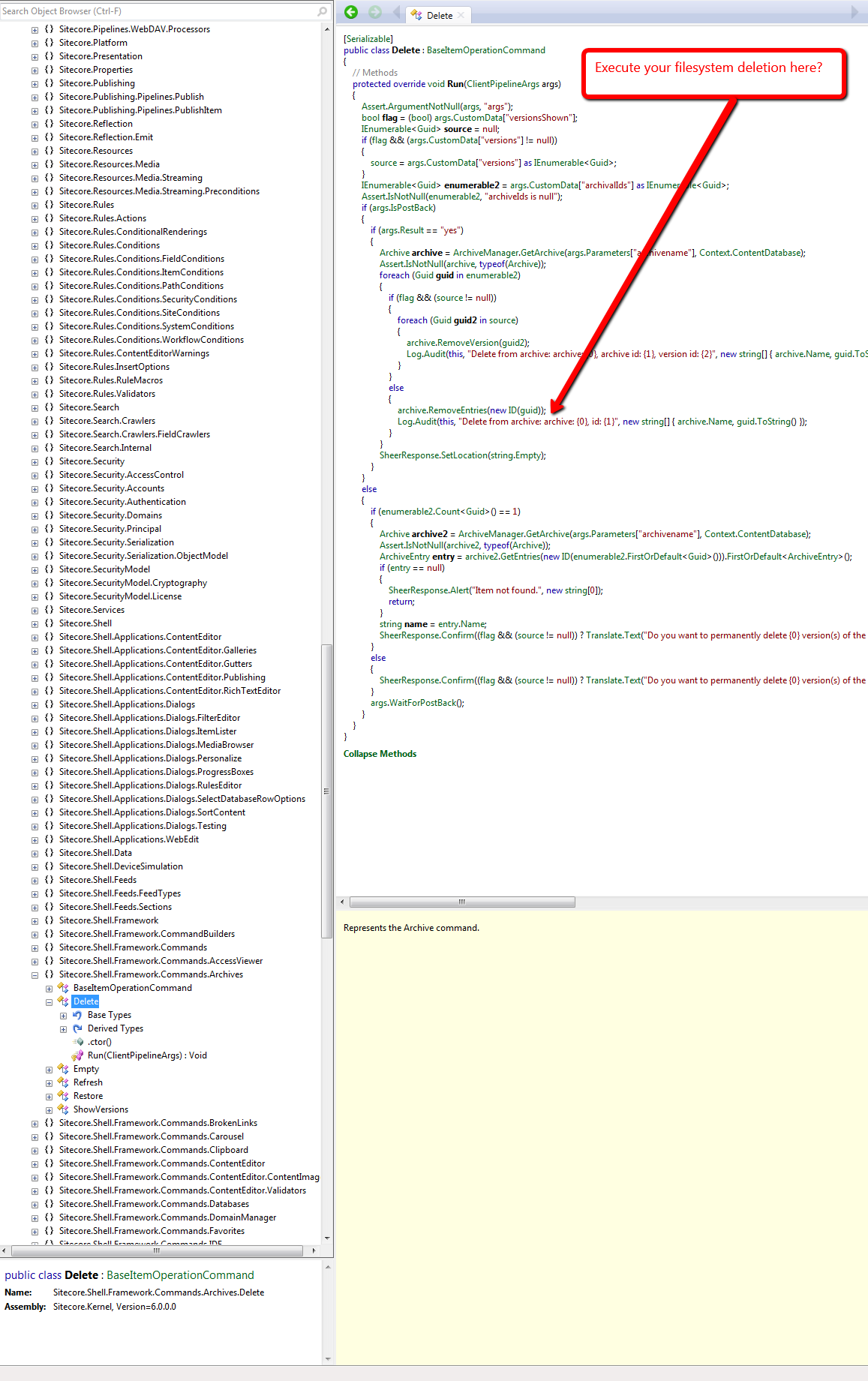
However, I wasn’t completely satisfied with this approach, especially when it would require a substantial amount of copying and pasting of code — a practice that I vehemently abhor — and decided to seek out a different, if not better, way of doing this.
From my research, I discovered that one could just create his/her own Archive class — it would have to ultimately derive from Sitecore.Data.Archiving.Archive in Sitecore.Kernel — which would delete a file on the filesystem associated with a Sitecore Item:
using System;
using System.IO;
using System.Linq;
using System.Web;

using Sitecore.Configuration;
using Sitecore.Data;
using Sitecore.Data.Archiving;
using Sitecore.Data.DataProviders.Sql;
using Sitecore.Diagnostics;

namespace Sitecore.Sandbox.Data.Archiving
{
    public class FileSystemHookSqlArchive : SqlArchive
    {
        private static readonly string FolderPath = GetFolderPath();

        public FileSystemHookSqlArchive(string name, Database database)
            : base(name, database)
        {
        }

        public override void RemoveEntries(ArchiveQuery query)
        {
            DeleteFromFileSystem(query);
            base.RemoveEntries(query);
        }

        protected virtual void DeleteFromFileSystem(ArchiveQuery query)
        {
            if (query.ArchivalId == Guid.Empty)
            {
                return;
            }

            Guid itemId = GetItemId(query.ArchivalId);
            if (itemId == Guid.Empty)
            {
                return;
            }

            string filePath = GetFilePath(itemId.ToString());
            if (string.IsNullOrWhiteSpace(filePath))
            {
                return;
            }

            TryDeleteFile(filePath);
        }

        private void TryDeleteFile(string filePath)
        {
            try
            {
                if (File.Exists(filePath))
                {
                    File.Delete(filePath);
                }
            }
            catch (Exception ex)
            {
                Log.Error(this.ToString(), ex, this);
            }
        }

        public virtual Guid GetItemId(Guid archivalId)
        {
            if (archivalId == Guid.Empty)
            {
                return Guid.Empty;
            }

            ArchiveQuery query = new ArchiveQuery
            {
                ArchivalId = archivalId
            };

            SqlStatement selectStatement = GetSelectStatement(query, "{0}ItemId{1}");
            if (selectStatement == null)
            {
                return Guid.Empty;
            }
            return GetGuid(selectStatement.Sql, selectStatement.GetParameters(), Guid.Empty);
        }

        private Guid GetGuid(string sql, object[] parameters, Guid defaultValue)
        {
            using (DataProviderReader reader = Api.CreateReader(sql, parameters))
            {
                if (!reader.Read())
                {
                    return defaultValue;
                }
                return Api.GetGuid(0, reader);
            }
        }

        private static string GetFilePath(string fileName)
        {
            string filePath = Directory.GetFiles(FolderPath, string.Concat(fileName, "*.*")).FirstOrDefault();
            if (!string.IsNullOrWhiteSpace(filePath))
            {
                return filePath;
            }

            return string.Empty;
        }

        private static string GetFolderPath()
        {
            return HttpContext.Current.Server.MapPath(Settings.GetSetting("FileSystemHookSqlArchive.Folder"));
        }
    }
}
In the subclass of Sitecore.Data.Archiving.SqlArchive above — I’m using Sitecore.Data.Archiving.SqlArchive since I’m using SqlServer for my Sitecore instance — I try to find a file that is named after its associated Item’s ID — minus the curly braces — in a folder that I’ve mapped in a configuration include file (see below).
I first have to get the Item’s ID from the database using the supplied ArchivalId — this is all the calling code gives us, so we have to make do with what we have.
If the file exists, we try to delete it — we do this before letting the base class delete the Item from Recycle Bin so that we can retrieve the Item’s ID from the database before it’s removed from the Archive database table — and log any errors we encounter upon exception.
I then hooked in an instance of the above Archive class in a custom Sitecore.Data.Archiving.ArchiveProvider class:
using System.Xml;

using Sitecore.Data;
using Sitecore.Data.Archiving;
using Sitecore.Xml;

namespace Sitecore.Sandbox.Data.Archiving
{
    public class FileSystemHookSqlArchiveProvider : SqlArchiveProvider
    {
        protected override Archive GetArchive(XmlNode configNode, Database database)
        {
            string attribute = XmlUtil.GetAttribute("name", configNode);
            if (string.IsNullOrEmpty(attribute))
            {
                return null;
            }

            return new FileSystemHookSqlArchive(attribute, database);
        }
    }
}
The above class — which derives from Sitecore.Data.Archiving.SqlArchiveProvider since I’m using SqlServer — only overrides its base class’s GetArchive factory method. We instantiate an instance of our Archive class instead of the “out of the box” Sitecore.Data.Archiving.SqlArchive class within it.
I then had to replace the “out of the box” Sitecore.Data.Archiving.ArchiveProvider reference, and define the location of our files in the following configuration file:
<?xml version="1.0" encoding="utf-8"?>
<configuration xmlns:patch="http://www.sitecore.net/xmlconfig/">
  <sitecore>
    <archives defaultProvider="sql" enabled="true">
      <providers>
        <add name="sql" patch:instead="add[@type='Sitecore.Data.Archiving.SqlArchiveProvider, Sitecore.Kernel']" type="Sitecore.Sandbox.Data.Archiving.FileSystemHookSqlArchiveProvider, Sitecore.Sandbox" database="*"/>
      </providers>
    </archives>
    <settings>
      <setting name="FileSystemHookSqlArchive.Folder" value="/test/" />
    </settings>
  </sitecore>
</configuration>
Let’s test this out.
I first created a test Item to delete:

I then had to create a test file on the filesystem in my test folder — the test folder lives in my Sitecore instance’s website root:

I deleted the test Item from the content tree, opened up the Recycle Bin, selected the test Item, and got an itchy trigger finger — I want to delete the Item forever 🙂 :

After clicking the Delete button, I saw that the file on the filesystem was deleted as well:

If you have any thoughts on this, or recommendations around making it better, please leave a comment.
Navigate to Base Templates of a Template using a Sitecore Command
Have you ever said to yourself when looking at base templates of a template in its Content tab “wouldn’t it be great if I could easily navigate to one of these?”
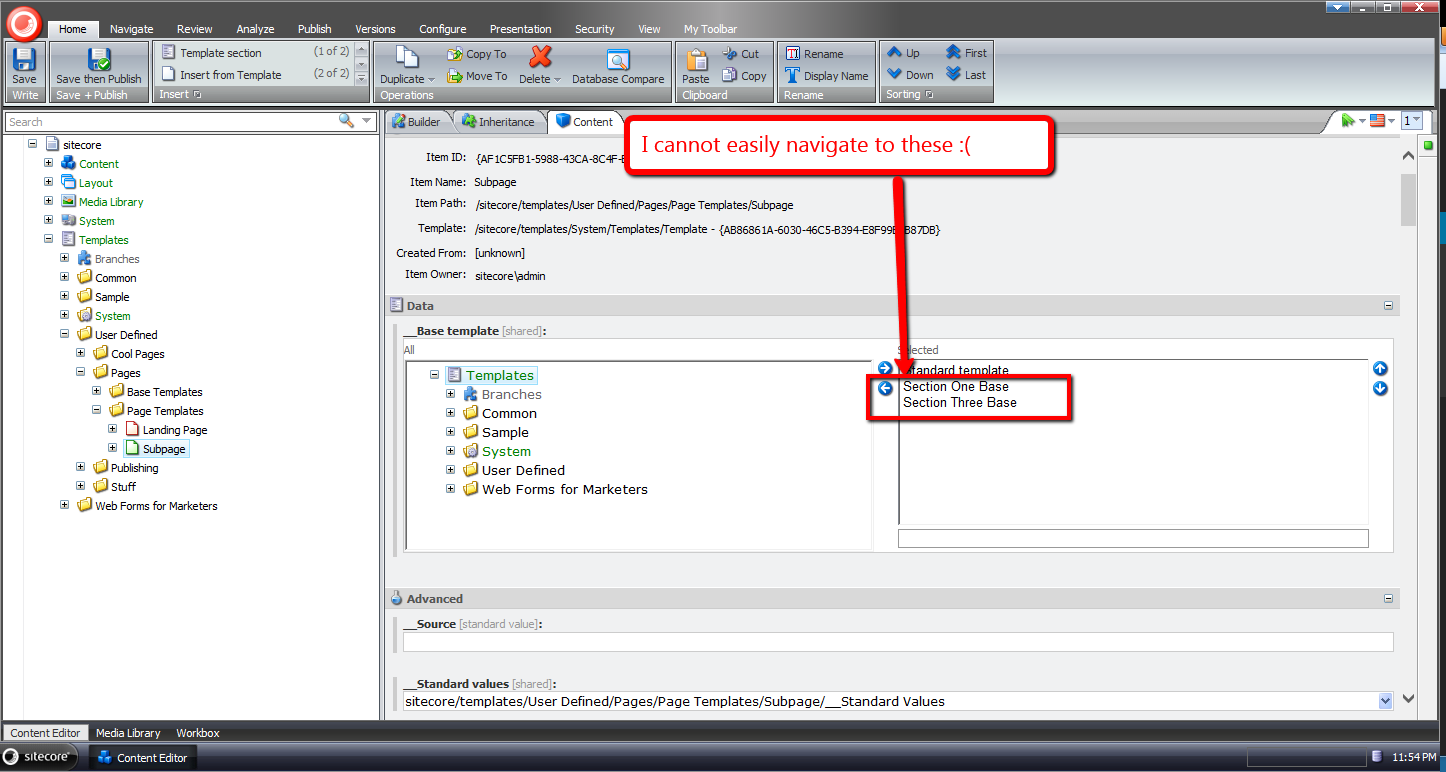
I have had this thought more than once despite having the ability to do this in a template’s Inheritance tab — you can do this by clicking one of the base template links listed:
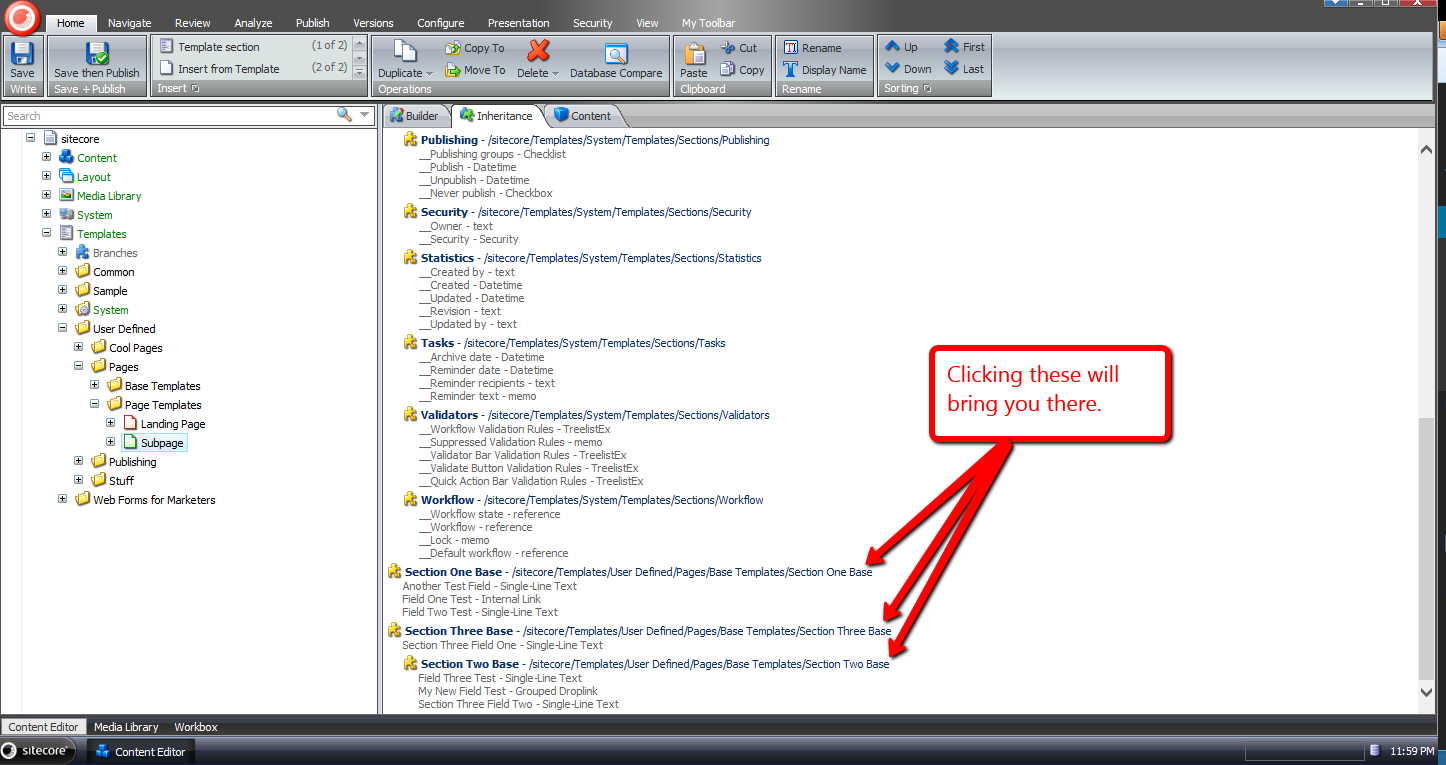
For some reason I sometimes forget you have the ability to get to a base template of a template in the Inheritance tab — why I forget is no doubt a larger issue I should try to tackle, albeit I’ll leave that for another day — and decided to build something that will be more difficult for me to forget: launching a dialog via a new item context menu option, and selecting one of the base templates of a template in that dialog.
I decided to atomize functionality in my solution by building custom pipelines/processors wherever I felt doing so made sense.
I started off by building a custom pipeline that gets base templates for a template, and defined a data transfer object (DTO) class for it:
using System.Collections.Generic;

using Sitecore.Data.Items;
using Sitecore.Pipelines;
using Sitecore.Web.UI.Sheer;

namespace Sitecore.Sandbox.Shell.Framework.Pipelines
{
    public class GetBaseTemplatesArgs : PipelineArgs
    {
        public TemplateItem TemplateItem { get; set; }

        public bool IncludeAncestorBaseTemplates { get; set; }

        private List<TemplateItem> _BaseTemplates;
        public List<TemplateItem> BaseTemplates
        {
            get
            {
                if (_BaseTemplates == null)
                {
                    _BaseTemplates = new List<TemplateItem>();
                }

                return _BaseTemplates;
            }
            set
            {
                _BaseTemplates = value;
            }
        }
    }
}
Client code must supply the template item that will be used as the starting point for gathering base templates, and can request all ancestor base templates — excluding the Standard Template as you will see below — by setting the IncludeAncestorBaseTemplates property to true.
I then created a class with a Process method that will serve as the only pipeline processor for my new pipeline:
using System;
using System.Collections.Generic;
using System.Linq;
using System.Text;

using Sitecore.Data.Items;
using Sitecore.Diagnostics;

namespace Sitecore.Sandbox.Shell.Framework.Pipelines
{
    public class GetBaseTemplates
    {
        public void Process(GetBaseTemplatesArgs args)
        {
            Assert.ArgumentNotNull(args, "args");
            Assert.ArgumentNotNull(args.TemplateItem, "args.TemplateItem");
            List<TemplateItem> baseTemplates = new List<TemplateItem>();
            GatherBaseTemplateItems(baseTemplates, args.TemplateItem, args.IncludeAncestorBaseTemplates);
            args.BaseTemplates = baseTemplates;
        }

        private static void GatherBaseTemplateItems(List<TemplateItem> baseTemplates, TemplateItem templateItem, bool includeAncestors)
        {
            if (includeAncestors)
            {
                foreach (TemplateItem baseTemplateItem in templateItem.BaseTemplates)
                {
                    GatherBaseTemplateItems(baseTemplates, baseTemplateItem, includeAncestors);
                }
            }

            if (!IsStandardTemplate(templateItem) && templateItem.BaseTemplates != null && templateItem.BaseTemplates.Any())
            {
                baseTemplates.AddRange(GetBaseTemplatesExcludeStandardTemplate(templateItem.BaseTemplates));
            }
        }

        private static IEnumerable<TemplateItem> GetBaseTemplatesExcludeStandardTemplate(TemplateItem templateItem)
        {
            if (templateItem == null)
            {
                return new List<TemplateItem>();
            }

            return GetBaseTemplatesExcludeStandardTemplate(templateItem.BaseTemplates);
        }

        private static IEnumerable<TemplateItem> GetBaseTemplatesExcludeStandardTemplate(IEnumerable<TemplateItem> baseTemplates)
        {
            if (baseTemplates != null && baseTemplates.Any())
            {
                return baseTemplates.Where(baseTemplate => !IsStandardTemplate(baseTemplate));
            }

            return baseTemplates;
        }

        private static bool IsStandardTemplate(TemplateItem templateItem)
        {
            return templateItem.ID == TemplateIDs.StandardTemplate;
        }
    }
}
Methods in the above class add base templates to a list when the templates are not the Standard Template — I thought it would be a rare occurrence for one to navigate to it, and decided not to include it in the collection.
Further, the method that gathers base templates is recursively executed when client code requests all ancestor base templates be include in the collection.
The next thing I built was functionality to prompt the user for a base template via a dialog, and track which base template was chosen. I decided to do this using a custom client processor, and built the following DTO for it:
using System;
using System.Collections.Generic;
using System.Linq;
using System.Text;
using Sitecore.Web.UI.Sheer;
using Sitecore.Data.Items;

namespace Sitecore.Sandbox.Shell.Framework.Pipelines
{
    public class GotoBaseTemplateArgs : ClientPipelineArgs
    {
        public TemplateItem TemplateItem { get; set; }

        public string SelectedBaseTemplateId { get; set; }
    }
}
Just like the other DTO defined above, client code must suppy a template item. The SelectedBaseTemplateId property is set after a user selects a base template in the modal launched by the following class:
using System.Collections.Generic;
using System.Linq;

using Sitecore.Data.Items;
using Sitecore.Data.Managers;
using Sitecore.Diagnostics;
using Sitecore.Pipelines;
using Sitecore.Shell.Applications.Dialogs.ItemLister;
using Sitecore.Web.UI.Sheer;

namespace Sitecore.Sandbox.Shell.Framework.Pipelines
{
    public class GotoBaseTemplate
    {
        public string SelectTemplateButtonText { get; set; }

        public string ModalIcon { get; set; }

        public string ModalTitle { get; set; }

        public string ModalInstructions { get; set; }

        public void SelectBaseTemplate(GotoBaseTemplateArgs args)
        {
            Assert.ArgumentNotNull(args, "args");
            Assert.ArgumentNotNull(args.TemplateItem, "args.TemplateItem");
            Assert.ArgumentNotNullOrEmpty(SelectTemplateButtonText, "SelectTemplateButtonText");
            Assert.ArgumentNotNullOrEmpty(ModalIcon, "ModalIcon");
            Assert.ArgumentNotNullOrEmpty(ModalTitle, "ModalTitle");
            Assert.ArgumentNotNullOrEmpty(ModalInstructions, "ModalInstructions");

            if (!args.IsPostBack)
            {
                ItemListerOptions itemListerOptions = new ItemListerOptions
                {
                    ButtonText = SelectTemplateButtonText,
                    Icon = ModalIcon,
                    Title = ModalTitle,
                    Text = ModalInstructions
                };

                itemListerOptions.Items = GetBaseTemplateItemsForSelection(args.TemplateItem).Select(template => template.InnerItem).ToList();
                itemListerOptions.AddTemplate(TemplateIDs.Template);
                SheerResponse.ShowModalDialog(itemListerOptions.ToUrlString().ToString(), true);
                args.WaitForPostBack();
            }
            else if (args.HasResult)
            {
                args.SelectedBaseTemplateId = args.Result;
                args.IsPostBack = false;
            }
            else
            {
                args.AbortPipeline();
            }
        }

        private IEnumerable<TemplateItem> GetBaseTemplateItemsForSelection(TemplateItem templateItem)
        {
            GetBaseTemplatesArgs args = new GetBaseTemplatesArgs
            {
                TemplateItem = templateItem,
                IncludeAncestorBaseTemplates = true,
            };
            CorePipeline.Run("getBaseTemplates", args);
            return args.BaseTemplates;
        }

        public void Execute(GotoBaseTemplateArgs args)
        {
            Assert.ArgumentNotNull(args, "args");
            Assert.ArgumentNotNullOrEmpty(args.SelectedBaseTemplateId, "args.SelectedBaseTemplateId");
            Context.ClientPage.ClientResponse.Timer(string.Format("item:load(id={0})", args.SelectedBaseTemplateId), 1);
        }
    }
}
The SelectBaseTemplate method above gives the user a list of base templates to choose from — this includes all ancestor base templates of a template minus the Standard Template.
The title, icon, helper text of the modal are supplied via the processor’s xml node in its configuration file — you’ll see this later on in this post.
Once a base template is chosen, its Id is then set in the SelectedBaseTemplateId property of the GotoBaseTemplateArgs instance.
The Execute method brings the user to the selected base template item in the Sitecore content tree.
Now we need a way to launch the code above.
I did this using a custom command that will be wired up to the item context menu:
using System.Collections.Generic;
using System.Linq;

using Sitecore.Data.Items;
using Sitecore.Data.Managers;
using Sitecore.Diagnostics;
using Sitecore.Shell.Framework.Commands;

using Sitecore.Sandbox.Shell.Framework.Pipelines;
using Sitecore.Web.UI.Sheer;
using Sitecore.Pipelines;

namespace Sitecore.Sandbox.Commands
{
    public class GotoBaseTemplateCommand : Command
    {
        public override void Execute(CommandContext context)
        {
            Context.ClientPage.Start("gotoBaseTemplate", new GotoBaseTemplateArgs { TemplateItem = GetItem(context) });
        }

        public override CommandState QueryState(CommandContext context)
        {
            if (ShouldEnable(GetItem(context)))
            {
                return CommandState.Enabled;
            }

            return CommandState.Hidden;
        }

        private static bool ShouldEnable(Item item)
        {
            return item != null
                    && IsTemplate(item)
                    && GetBaseTemplates(item).Any();
        }

        private static Item GetItem(CommandContext context)
        {
            Assert.ArgumentNotNull(context, "context");
            Assert.ArgumentNotNull(context.Items, "context.Items");
            return context.Items.FirstOrDefault();
        }

        private static bool IsTemplate(Item item)
        {
            Assert.ArgumentNotNull(item, "item");
            return TemplateManager.IsTemplate(item);
        }

        private static IEnumerable<TemplateItem> GetBaseTemplates(TemplateItem templateItem)
        {
            Assert.ArgumentNotNull(templateItem, "templateItem");
            GetBaseTemplatesArgs args = new GetBaseTemplatesArgs
            {
                TemplateItem = templateItem,
                IncludeAncestorBaseTemplates = false
            };

            CorePipeline.Run("getBaseTemplates", args);
            return args.BaseTemplates;
        }
    }
}
The command above is visible only when the item is a template, and has base templates on it — we invoke the custom pipeline built above to get base templates.
When the command is invoked, we call our custom client processor to prompt the user for a base template to go to.
I then glued everything together using the following configuration file:
<?xml version="1.0" encoding="utf-8" ?>
<configuration>
  <sitecore>
    <commands>
      <command name="item:GotoBaseTemplate" type="Sitecore.Sandbox.Commands.GotoBaseTemplateCommand, Sitecore.Sandbox"/>
    </commands>
    <pipelines>
      <getBaseTemplates>
        <processor type="Sitecore.Sandbox.Shell.Framework.Pipelines.GetBaseTemplates, Sitecore.Sandbox"/>
      </getBaseTemplates>
    </pipelines>
    <processors>
      <gotoBaseTemplate>
        <processor mode="on" type="Sitecore.Sandbox.Shell.Framework.Pipelines.GotoBaseTemplate, Sitecore.Sandbox" method="SelectBaseTemplate">
          <SelectTemplateButtonText>OK</SelectTemplateButtonText>
          <ModalIcon>Applications/32x32/nav_up_right_blue.png</ModalIcon>
          <ModalTitle>Select A Base Template</ModalTitle>
          <ModalInstructions>Select the base template you want to navigate to.</ModalInstructions>
        </processor>
        <processor mode="on" type="Sitecore.Sandbox.Shell.Framework.Pipelines.GotoBaseTemplate, Sitecore.Sandbox" method="Execute"/>
      </gotoBaseTemplate>
    </processors>
  </sitecore>
</configuration>
I’ve left out how I’ve added the command shown above to the item context menu in the core database. For more information on adding to the item context menu, please see part one and part two of my post showing how to do this.
Let’s see how we did.
I first created some templates for testing. The following template named ‘Meta’ uses two other test templates as base templates:

I also created a ‘Base Page’ template which uses the ‘Meta’ template above:

Next I created ‘The Coolest Page Template Ever’ template — this uses the ‘Base Page’ template as its base template:

I then right-clicked on ‘The Coolest Page Template Ever’ template to launch its context menu, and selected our new menu option:
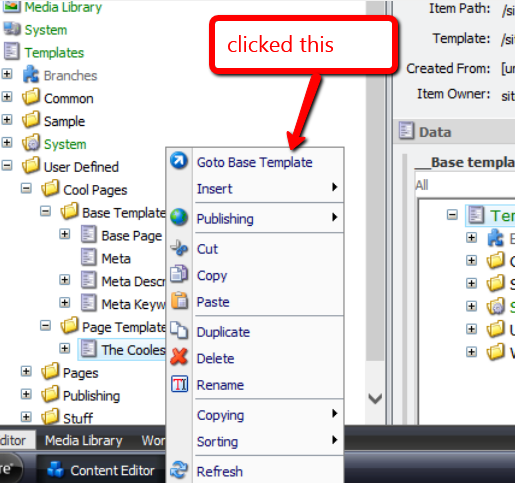
I was then presented with a dialog asking me to select the base template I want to navigate to:

I chose one of the base templates, and clicked ‘OK’:

I was then brought to the base template I had chosen:
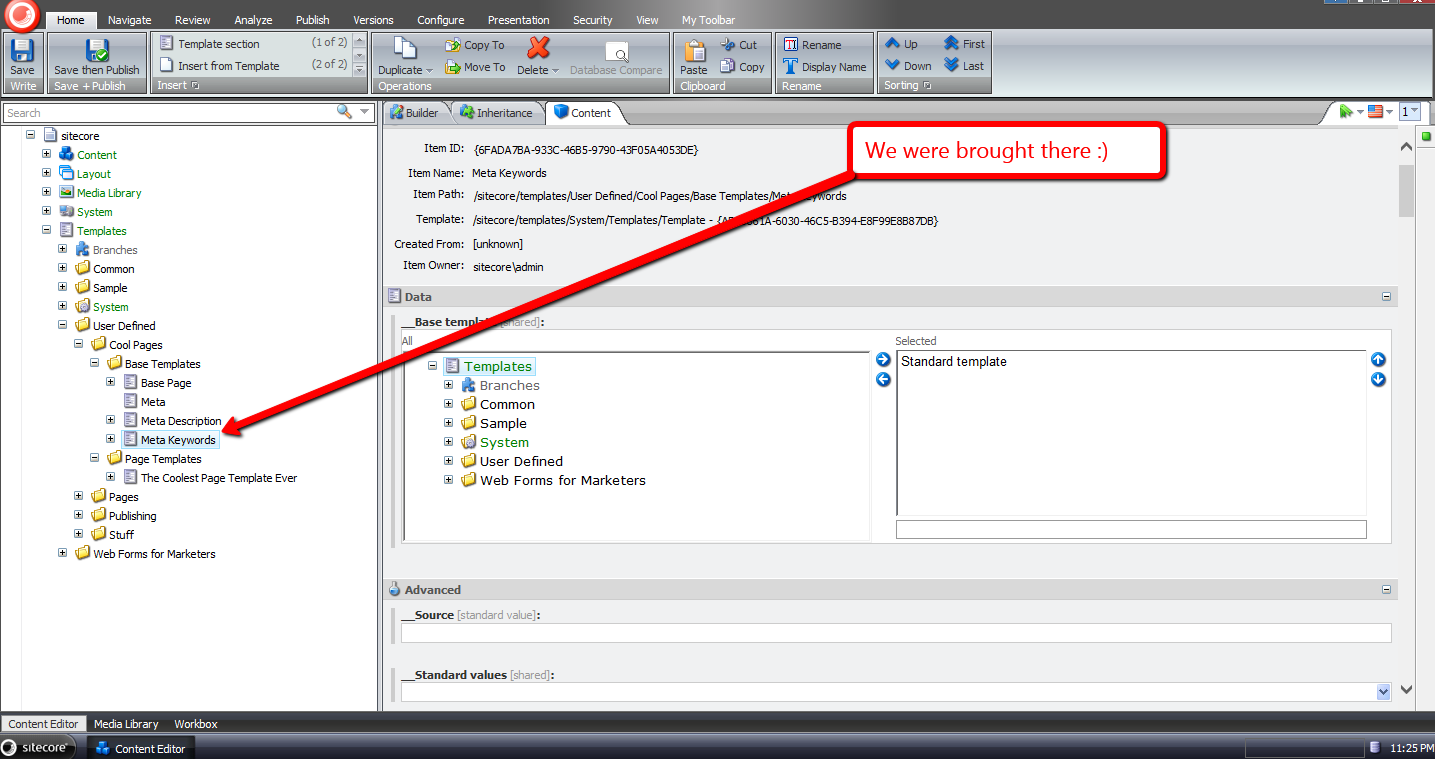
If you have any thoughts on this, please leave a comment.
Content Manage Links to File System Favicons for Multiple Sites Managed in Sitecore
Earlier today someone started a thread in one of the SDN forums asking how to go about adding the ability to have a different favicon for each website managed in the same instance of Sitecore.
I had implemented this in the past for a few clients, and thought I should write a post on how I had done this.
In most of those solutions, the site’s start item would contain a “server file” field — yes I know it’s deprecated but it works well for this (if you can suggested a better field type to use, please leave a comment below) — that would point to a favicon on the file system:

Content authors/editors can then choose the appropriate favicon for each site managed in their Sitecore instance — just like this:

Not long after the SDN thread was started, John West — Chief Technology Officer at Sitecore USA — wrote a quick code snippet, followed by a blog post on how one might go about doing this.
John’s solution is a different than the one I had used in the past — each site’s favicon is defined on its site node in the Web.config.
After seeing John’s solution, I decided I would create a hybrid solution — the favicon set on the start item would have precedence over the one defined on the site node in the Web.config. In other words, the favicon defined on the site node would be a fallback.
For this hybrid solution, I decided to create a custom pipeline to retrieve the favicon for the context site, and created the following pipeline arguments class for it:
using System.Web.UI;

using Sitecore.Pipelines;

namespace Sitecore.Sandbox.Pipelines.GetFavicon
{
    public class FaviconTryGetterArgs : PipelineArgs
    {
        public string FaviconUrl { get; set; }

        public Control FaviconControl{ get; set; }
    }
}
The idea is to have pipeline processors set the URL of the favicon if possible, and have another processor create an ASP.NET control for the favicon when the URL is supplied.
The following class embodies this high-level idea:
using System;

using System.Web.UI;
using System.Web.UI.HtmlControls;

using Sitecore;
using Sitecore.Configuration;
using Sitecore.Data.Fields;
using Sitecore.Data.Items;
using Sitecore.Diagnostics;
using Sitecore.Sandbox.Utilities.Extensions;

namespace Sitecore.Sandbox.Pipelines.GetFavicon
{
    public class FaviconTryGetter
    {
        private string FaviconFieldName { get; set; }

        public void TryGetFromStartItem(FaviconTryGetterArgs args)
        {
            Assert.ArgumentNotNull(args, "args");
            bool canProcess = !string.IsNullOrWhiteSpace(FaviconFieldName)
                                && Context.Site != null
                                && !string.IsNullOrWhiteSpace(Context.Site.StartPath);

            if (!canProcess)
            {
                return;
            }

            Item startItem = Context.Database.GetItem(Context.Site.StartPath);
            args.FaviconUrl = startItem[FaviconFieldName];
        }

        public void TryGetFromSite(FaviconTryGetterArgs args)
        {
            Assert.ArgumentNotNull(args, "args");
            bool canProcess = Context.Site != null
                                && string.IsNullOrWhiteSpace(args.FaviconUrl);

            if (!canProcess)
            {
                return;
            }

			/* GetFavicon is an extension method borrowed from John West. You can find it at  http://www.sitecore.net/Community/Technical-Blogs/John-West-Sitecore-Blog/Posts/2013/08/Use-Different-Shortcut-Icons-for-Different-Managed-Sites-with-the-Sitecore-ASPNET-CMS.aspx
            */
            args.FaviconUrl = Context.Site.GetFavicon();
        }

        public void TryGetFaviconControl(FaviconTryGetterArgs args)
        {
            Assert.ArgumentNotNull(args, "args");
            if(string.IsNullOrWhiteSpace(args.FaviconUrl))
            {
                return;
            }

            args.FaviconControl = CreateNewFaviconControl(args.FaviconUrl);
        }

        private static Control CreateNewFaviconControl(string faviconUrl)
        {
            Assert.ArgumentNotNullOrEmpty(faviconUrl, "faviconUrl");
            HtmlLink link = new HtmlLink();
            link.Attributes.Add("type", "image/x-icon");
            link.Attributes.Add("rel", "icon");
            link.Href = faviconUrl;
            return link;
        }
    }
}
The TryGetFromStartItem method tries to get the favicon set on the favicon field on the start item — the name of the field is supplied via one of the processors defined in the configuration include file below — and sets it on the FaviconUrl property of the FaviconTryGetterArgs instance supplied by the caller.
If the field name for the field containing the favicon is not supplied, or there is something wrong with either the context site or the start item’s path, then the method does not finish executing.
The TryGetFromSite method is similar to what John had done in his post. It uses the same exact extension method John had used for getting the favicon off of a “favicon” attribute set on the context site’s node in the Web.config — I have omitted this extension method and its class since you can check it out in John’s post.
If a URL is set by either of the two methods discussed above, the TryGetFaviconControl method creates an instance of an HtmlLink System.Web.UI.HtmlControls.HtmlControl, sets the appropriate attributes for an html favicon link tag, and sets it in the FaviconControl property of the FaviconTryGetterArgs instance.
I assembled the methods above into a new getFavicon pipeline in the following configuration include file, and also set a fallback favicon for my local sandbox site’s configuration element:
<?xml version="1.0" encoding="utf-8"?>
<configuration xmlns:patch="http://www.sitecore.net/xmlconfig/">
  <sitecore>
    <pipelines>
      <getFavicon>
        <processor type="Sitecore.Sandbox.Pipelines.GetFavicon.FaviconTryGetter, Sitecore.Sandbox" method="TryGetFromStartItem">
          <FaviconFieldName>Favicon</FaviconFieldName>
        </processor>
        <processor type="Sitecore.Sandbox.Pipelines.GetFavicon.FaviconTryGetter, Sitecore.Sandbox" method="TryGetFromSite" />
        <processor type="Sitecore.Sandbox.Pipelines.GetFavicon.FaviconTryGetter, Sitecore.Sandbox" method="TryGetFaviconControl" />
      </getFavicon>
    </pipelines>
    <sites>
      <site name="website">
        <patch:attribute name="favicon">/sitecore.ico</patch:attribute>
      </site>
    </sites>
  </sitecore>
</configuration>
Just as John West had done in his post, I created a custom WebControl for rendering the favicon, albeit the following class invokes our new pipeline above to get the favicon ASP.NET control:
using System.Web.UI;

using Sitecore.Pipelines;
using Sitecore.Sandbox.Pipelines.GetFavicon;
using Sitecore.Web.UI;

namespace Sitecore.Sandbox.WebControls
{
    public class Favicon : WebControl
    {
        protected override void DoRender(HtmlTextWriter output)
        {
            FaviconTryGetterArgs args = new FaviconTryGetterArgs();
            CorePipeline.Run("getFavicon", args);
            if (args.FaviconControl != null)
            {
                args.FaviconControl.RenderControl(output);
            }
        }
    }
}
If a favicon Control is supplied by our new getFavicon pipeline, the WebControl then delegates rendering responsibility to it.
I then defined an instance of the WebControl above in my default layout:
<%@ Register TagPrefix="sj" Namespace="Sitecore.Sharedsource.Web.UI.WebControls" Assembly="Sitecore.Sharedsource" %>
...
<html>
  <head>
  ...
  <sj:Favicon runat="server" />
  ...
For testing, I found a favicon generator website out on the internet — I won’t share this since it’s appeared to be a little suspect — and created a smiley face favicon. I set this on my start item, and published:

After clearing it out on my start item, and publishing, the fallback Sitecore favicon appears:
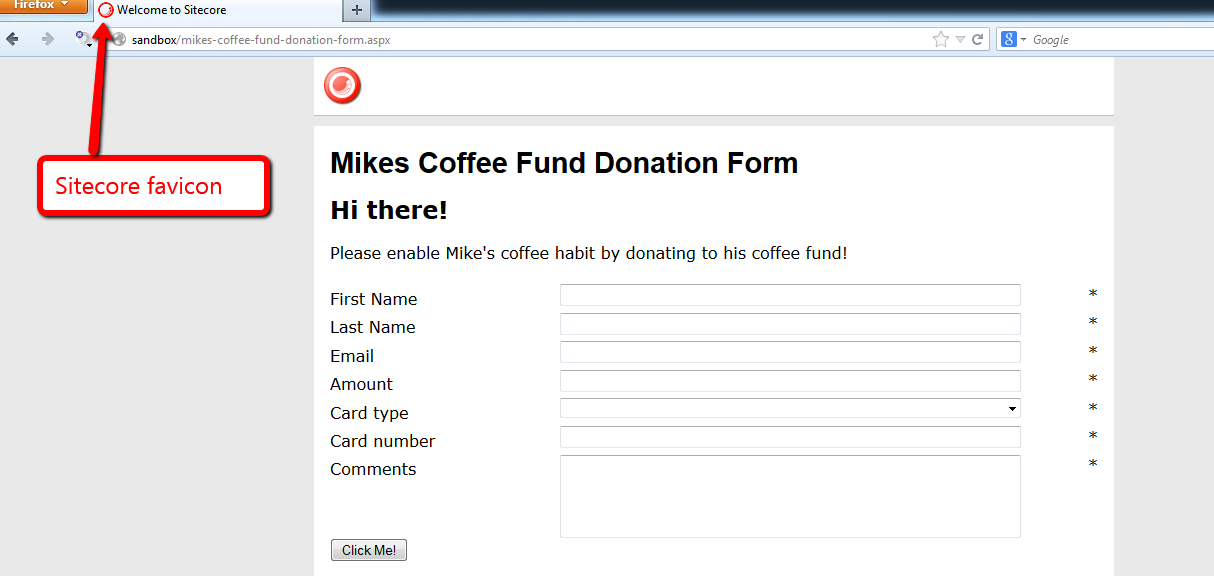
When you remove all favicons, none appear.

If you have any thoughts, suggestions, or comments on this, please share below.
Delete An Item Across Multiple Databases in Sitecore
Have you ever thought “wouldn’t it be handy to have the ability to delete an item across multiple databases in Sitecore?” In other words, wouldn’t it be nice to not have to publish the parent of an item — with sub-items — after deleting it, just to remove it from a target database?
This particular thought has crossed my mind more than once, and I decided to do something about it. This post showcases what I’ve done.
I spent some time surfing through Sitecore.Kernel.dll and Sitecore.Client.dll in search of a dialog that allows users to select multiple options simultaneously but came up shorthanded — if you are aware of one, please leave a comment — so I had to roll my own:
<?xml version="1.0" encoding="utf-8" ?>
<control xmlns:def="Definition" xmlns="http://schemas.sitecore.net/Visual-Studio-Intellisense">
	<DeleteInDatabases>
		<FormDialog ID="DeleteInDatabasesDialog" Icon="Business/32x32/data_delete.png" Header="Delete Item In Databases"
		  Text="Select the databases where you want to delete the item." OKButton="Delete">

		  <CodeBeside Type="Sitecore.Sandbox.Shell.Applications.Dialogs.DeleteInDatabasesForm,Sitecore.Sandbox"/>
		  <GridPanel Width="100%" Height="100%" Style="table-layout:fixed">
			<Border Padding="4" ID="Databases"/>
		  </GridPanel>
		</FormDialog>
	</DeleteInDatabases>
</control>
using System;
using System.Collections.Generic;
using System.Linq;
using System.Web.UI;
using System.Web.UI.HtmlControls;

using Sitecore.Configuration;
using Sitecore.Data;
using Sitecore.Data.Items;
using Sitecore.Diagnostics;
using Sitecore.Web;
using Sitecore.Web.UI.HtmlControls;
using Sitecore.Web.UI.Pages;
using Sitecore.Web.UI.Sheer;

namespace Sitecore.Sandbox.Shell.Applications.Dialogs
{
    public class DeleteInDatabasesForm : DialogForm
    {
        private const string DatabaseCheckboxIDPrefix = "db_";

        protected Border Databases;

        private string _ItemId;
        protected string ItemId
        {
            get
            {
                if (string.IsNullOrWhiteSpace(_ItemId))
                {
                    _ItemId = WebUtil.GetQueryString("id");
                }

                return _ItemId;
            }
        }

        protected override void OnLoad(EventArgs e)
        {
            AddDatabaseCheckboxes();
            base.OnLoad(e);
        }

        private void AddDatabaseCheckboxes()
        {
            Databases.Controls.Clear();
            foreach (string database in GetDatabasesForSelection())
            {
                HtmlGenericControl checkbox = new HtmlGenericControl("input");
                Databases.Controls.Add(checkbox);
                checkbox.Attributes["type"] = "checkbox";
                checkbox.Attributes["value"] = database;
                string checkboxId = string.Concat(DatabaseCheckboxIDPrefix, database);
                checkbox.ID = checkboxId;
                HtmlGenericControl label = new HtmlGenericControl("label");
                Databases.Controls.Add(label);
                label.Attributes["for"] = checkboxId;
                label.InnerText = database;
                Databases.Controls.Add(new LiteralControl("<br>"));
            }
        }

        private static IEnumerable<string> GetDatabasesForSelection()
        {
            return WebUtil.GetQueryString("db").Split("|".ToCharArray(), StringSplitOptions.RemoveEmptyEntries);
        }

        protected override void OnOK(object sender, EventArgs args)
        {
            IEnumerable<string> selectedDatabases = GetSelectedDabases();
            if (!selectedDatabases.Any())
            {
                SheerResponse.Alert("Please select at least one database!");
                return;
            }

            DeleteItemInDatabases(selectedDatabases, ItemId);
            SheerResponse.Alert("The item has been deleted in all selected databases!");
            base.OnOK(sender, args);
        }

        private static IEnumerable<string> GetSelectedDabases()
        {
            IList<string> databases = new List<string>();
            foreach (string id in Context.ClientPage.ClientRequest.Form.Keys)
            {
                if (!string.IsNullOrWhiteSpace(id) && id.StartsWith(DatabaseCheckboxIDPrefix))
                {
                    databases.Add(id.Substring(3));
                }
            }

            return databases;
        }

        private static void DeleteItemInDatabases(IEnumerable<string> databases, string itemId)
        {
            foreach(string database in databases)
            {
                DeleteItemInDatabase(database, itemId);
            }
        }

        private static void DeleteItemInDatabase(string databaseName, string itemId)
        {
            Assert.ArgumentNotNullOrEmpty(databaseName, "databaseName");
            Assert.ArgumentNotNullOrEmpty(itemId, "itemId");
            Database database = Factory.GetDatabase(databaseName);
            Assert.IsNotNull(database, "Invalid database!");
            DeleteItem(database.GetItem(itemId));
        }

        private static void DeleteItem(Item item)
        {
            Assert.ArgumentNotNull(item, "item");
            if (Settings.RecycleBinActive)
            {
                item.Recycle();
            }
            else
            {
                item.Delete();
            }
        }
    }
}
The dialog above takes in an item’s ID — this is the ID of the item the user has chosen to delete across multiple databases — and a list of databases a user can choose from as checkboxes.
Ideally the item should exist in each database, albeit the code will throw an exception via an assertion in the case when client code supplies a database, the user selects it, and the item does not live in it.
If the user does not check off one checkbox, and clicks the ‘Delete’ button, an ‘Alert’ box will let the user know s/he must select at least one database.
When databases are selected, and the ‘Delete’ button is clicked, the item will be deleted — or put into the Recycle Bin — in all selected databases.
Now we need a way to launch this dialog. I figured it would make sense to have it be available from the item context menu — just as the ‘Delete’ menu option is available there “out of the box” — and built the following command for it:
using System;
using System.Collections.Generic;
using System.Linq;

using Sitecore.Configuration;
using Sitecore.Data.Items;
using Sitecore.Diagnostics;
using Sitecore.Shell.Framework.Commands;
using Sitecore.Text;
using Sitecore.Web.UI.Sheer;

namespace Sitecore.Sandbox.Commands
{
    public class DeleteInDatabases : Command
    {
        public override void Execute(CommandContext commandContext)
        {
            Context.ClientPage.Start(this, "ShowDialog", CreateNewClientPipelineArgs(GetItem(commandContext)));
        }

        private static ClientPipelineArgs CreateNewClientPipelineArgs(Item item)
        {
            Assert.ArgumentNotNull(item, "item");
            ClientPipelineArgs args = new ClientPipelineArgs();
            args.Parameters["ItemId"] = item.ID.ToString();
            args.Parameters["ParentId"] = item.ParentID.ToString();
            return args;
        }

        private void ShowDialog(ClientPipelineArgs args)
        {
            if (!args.IsPostBack)
            {
                SheerResponse.ShowModalDialog
                (
                    GetDialogUrl
                    (
                        GetDatabasesForItem(args.Parameters["ItemId"]),
                        args.Parameters["ItemId"]
                    ),
                    "300px",
                    "500px",
                    string.Empty,
                    true
               );

               args.WaitForPostBack();
            }
            else
            {
                RefreshChildren(args.Parameters["ParentId"]);
            }
        }

        private void RefreshChildren(string parentId)
        {
            Assert.ArgumentNotNullOrEmpty(parentId, "parentId");
            Context.ClientPage.SendMessage(this, string.Format("item:refreshchildren(id={0})", parentId));
        }

        public override CommandState QueryState(CommandContext commandContext)
        {
            bool shouldEnable = Context.User.IsAdministrator
                                && IsInDatabasesOtherThanCurrentContent(GetItem(commandContext));

            if (shouldEnable)
            {
                return CommandState.Enabled;
            }

            return CommandState.Hidden;
        }

        private static bool IsInDatabasesOtherThanCurrentContent(Item item)
        {
            Assert.ArgumentNotNull(item, "item");
            return GetDatabasesForItem(item.ID.ToString()).Count() > 1;
        }
        private static Item GetItem(CommandContext commandContext)
        {
            Assert.ArgumentNotNull(commandContext, "commandContext");
            Assert.ArgumentNotNull(commandContext.Items, "commandContext.Items");
            return commandContext.Items.FirstOrDefault();
        }

        private static IEnumerable<string> GetDatabasesForItemExcludingContentDB(string id)
        {
            return GetDatabasesForItem(id).Where(db => string.Equals(db, Context.ContentDatabase.Name, StringComparison.CurrentCultureIgnoreCase));
        }

        private static IEnumerable<string> GetDatabasesForItem(string id)
        {
            Assert.ArgumentNotNullOrEmpty(id, "id");
            return (from database in Factory.GetDatabases()
                    let itemInDatabase = database.GetItem(id)
                    where itemInDatabase != null
                    select database.Name).ToList();
        }

        private static string GetDialogUrl(IEnumerable<string> databases, string id)
        {
            Assert.ArgumentNotNullOrEmpty(id, "id");
            Assert.ArgumentNotNull(databases, "databases");
            Assert.ArgumentCondition(databases.Any(), "databases", "At least one database should be supplied!");
            UrlString urlString = new UrlString(UIUtil.GetUri("control:DeleteInDatabases"));
            urlString.Append("id", id);
            urlString.Append("db", string.Join("|", databases));
            return urlString.ToString();
        }
    }
}
The command is only visible when the item is in another database other than the context content database and the user is an admin.
When the item context menu option is clicked, the command passes a pipe delimited list of database names — only databases that contain the item — and the item’s ID to the dialog through its query string.
Once the item is deleted via the dialog, control is returned back to the command, and it then refreshes all siblings of the deleted item — this is done so the deleted item is removed from the content tree if the context content database was chosen in the dialog.
I then made this command available in Sitecore using a configuration include file:
<?xml version="1.0"?>
<configuration xmlns:patch="http://www.sitecore.net/xmlconfig/">
  <sitecore>
    <commands>
      <command name="item:DeleteInDatabases" type="Sitecore.Sandbox.Commands.DeleteInDatabases,Sitecore.Sandbox"/>
    </commands>
  </sitecore>
</configuration>
I’ve omitted the step on how I’ve wired this up to the item context menu in the core database. For more information on adding to the item context menu, please see part one and part two of my post showing how to do this.
Let’s see this in action.
I navigated to a test item that lives in the master and web databases, and launched its item context menu:

I clicked the ‘Delete in Databases’ menu option, and was presented with this dialog:
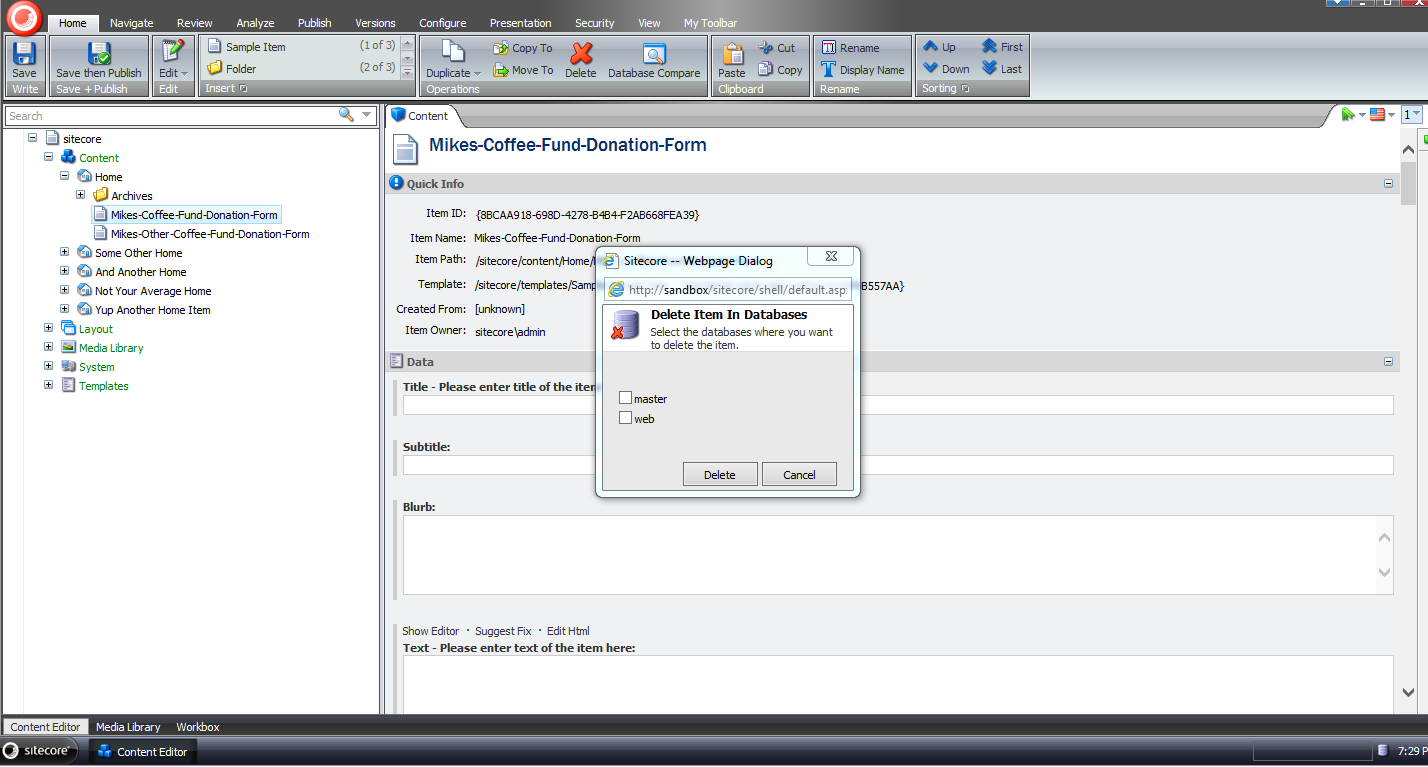
I got excited and forgot to select a database before clicking the ‘Delete’ button:

I then selected all databases, and clicked ‘Delete’:

When the dialog closed, we can see that our test item is gone:

Rest assured, it’s in the Recycle Bin:

It was also deleted in the web database as well — I’ve omitted screenshots of this since they would be identical to the last two screenshots above.
If you have any thoughts on this, or recommendations on making it better, please share in a comment.
Until next time, have a Sitecoretastic day!
Add JavaScript to the Client OnClick Event of the Sitecore WFFM Submit Button
A SDN forum thread popped up a week and a half ago asking whether it were possible to attach a Google Analytics event to the WFFM submit button — such would involve adding a snippet of JavaScript to the OnClick attribute of the WFFM submit button’s HTML — and I was immediately curious how one would go about achieving this, and whether this were possible at all.
I did a couple of hours of research last night — I experimented with custom processors of pipelines used by WFFM — but found no clean way of adding JavaScript to the OnClick event of the WFFM submit button.
However — right before I was about to throw in the towel for the night — I did find a solution on how one could achieve this — albeit not necessarily a clean solution since it involves some HTML manipulation (I would opine using the OnClientClick attribute of an ASP.NET Button to be cleaner, but couldn’t access the WFFM submit button due to its encapsulation and protection level in a WFFM WebControl) — via a custom Sitecore.Form.Core.Renderings.FormRender:
using System.IO;
using System.Linq;
using System.Web.UI;

using Sitecore.Form.Core.Renderings;

using HtmlAgilityPack;

namespace Sitecore.Sandbox.Form.Core.Renderings
{
    public class AddOnClientClickFormRender : FormRender
    {
        private const string ConfirmJavaScriptFormat = "if(!confirm('Are you sure you want to submit this form?')) {{ return false; }} {0} ";

        protected override void DoRender(HtmlTextWriter output)
        {
            string html = string.Empty;
            using (StringWriter stringWriter = new StringWriter())
            {
                using (HtmlTextWriter htmlTextWriter = new HtmlTextWriter(stringWriter))
                {
                    base.DoRender(htmlTextWriter);
                }

                html = AddOnClientClickToSubmitButton(stringWriter.ToString());
            }

            output.Write(html);
        }

        private static string AddOnClientClickToSubmitButton(string html)
        {
            if (string.IsNullOrWhiteSpace(html))
            {
                return html;
            }

            HtmlNode submitButton = GetSubmitButton(html);
            if (submitButton == null && submitButton.Attributes["onclick"] != null)
            {
                return html;
            }

            submitButton.Attributes["onclick"].Value = string.Format(ConfirmJavaScriptFormat, submitButton.Attributes["onclick"].Value);
            return submitButton.OwnerDocument.DocumentNode.InnerHtml;
        }

        private static HtmlNode GetSubmitButton(string html)
        {
            HtmlNode documentNode = GetHtmlDocumentNode(html);
            return documentNode.SelectNodes("//input[@type='submit']").FirstOrDefault();
        }

        private static HtmlNode GetHtmlDocumentNode(string html)
        {
            HtmlDocument htmlDocument = CreateNewHtmlDocument(html);
            return htmlDocument.DocumentNode;
        }

        private static HtmlDocument CreateNewHtmlDocument(string html)
        {
            HtmlDocument htmlDocument = new HtmlDocument();
            htmlDocument.LoadHtml(html);
            return htmlDocument;
        }
    }
}
The FormRender above uses Html Agility Pack — which comes with Sitecore — to retrieve the submit button in the HTML that is constructed by the base FormRender class, and adds a snippet of JavaScript to the beginning of the OnClick attribute (there is already JavaScript in this attribute, and we want to run our JavaScript first).
I didn’t wire up a Google Analytics event to the submit button in this FormRender — it would’ve required me to spin up an account for my local sandbox instance, and I feel this would’ve been overkill for this post.
Instead — as an example of adding JavaScript to the OnClick attribute of the WFFM submit button — I added code to launch a JavaScript confirmation dialog asking the form submitter whether he/she would like to continue submitting the form. If the user clicks the ‘Cancel’ button, the form is not submitted, and is submitted if the user clicks ‘OK’.
I then had to hook this custom FormRender to the WFFM Form Rendering — /sitecore/layout/Renderings/Modules/Web Forms for Marketers/Form — in Sitecore:

I then saved, published, and navigated to a WFFM test form. I then clicked the submit button:
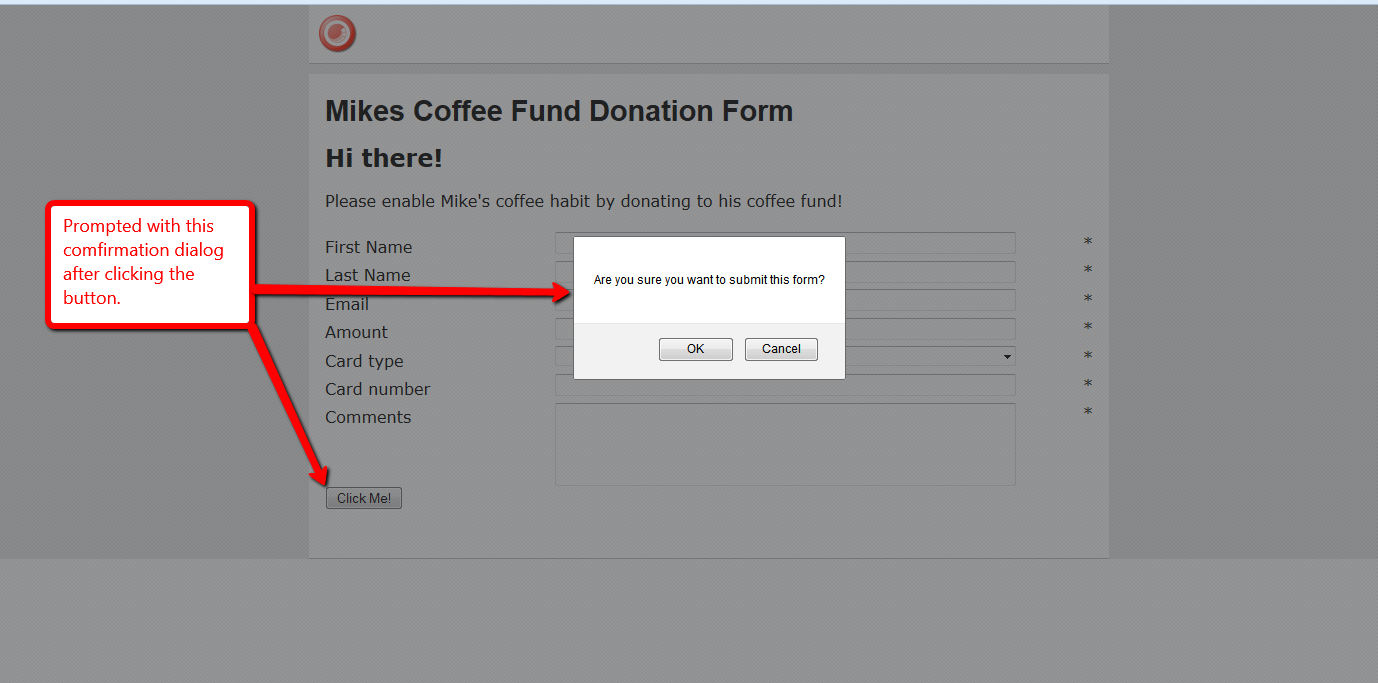
As you can see, I was prompted with a JavaScript confirmation dialog box.
If you have any thoughts on this implementation, or know of a better way to do this, please drop a comment.
Until next time, have a Sitecorelicious day! 🙂
Change the Data Serialization Format in the Sitecore Item Web API
I had a major urge yesterday to continue my tinkering of the Sitecore Item Web API, and wondered how one would go about changing the serialization format of its response.
Without re-reading the documentation on how one could go about doing this — I forgot that this was discussed in its documentation (check out pages 16-17 in the Sitecore Item Web API 1.0.0 Developer’s Guide where you can see how to use an XML serializer) — I tackled this by experimentation, and came up with a slightly different solution than the one offered in the Developer’s Guide.
I considered using an XML serializer for this blog post, but decided to fish around on the internet to see what other data serialization formats exist, and discovered YAML — a format that looks similar to JSON.
I continued my internet surfing — I mean research — and found a .NET library — YamlDotNet — that assists developers in converting objects into YAML, and decided to give it a go.
The following Sitecore item Web API Serializer uses this YAML library:
using System;
using System.Collections.Generic;
using System.IO;
using System.Linq;
using System.Text;

using Sitecore.Diagnostics;
using Sitecore.ItemWebApi.Serialization;

using YamlDotNet.RepresentationModel.Serialization;

namespace Sitecore.Sandbox.ItemWebApi.Serialization
{
    public class YamlSerializer : ISerializer
    {
        // Serializer in YamlDotNet.RepresentationModel.Serialization
        private static readonly Serializer Serializer = new Serializer();

        public YamlSerializer()
        {
        }

        public string Serialize(object value)
        {
            Assert.ArgumentNotNull(value, "value");
            string yaml = string.Empty;
            using(StringWriter stringWriter = new StringWriter())
            {
                Serializer.Serialize(stringWriter, value);
                yaml = stringWriter.ToString();
            }

            return yaml;
        }

        public string SerializedDataMediaType
        {
            get
            {
                return "application/x-yaml";
            }
        }
    }
}
The Serializer above just delegates responsibility to the YamlDotNet’s YAML serializer.
Now that we have our YamlSerializer ready to go, we have to somehow wire it up to the Sitecore Item Web API.
After some digging in Sitecore.ItemWebApi.dll, I learned the out of the box JsonSerializer is set in a preprocessRequest pipeline processor:

Following this lead, I created a custom preprocessRequest pipeline processor for setting our new YamlSerializer:
using System;
using System.Web;

using Sitecore.Pipelines.PreprocessRequest;
using Sitecore.Diagnostics;
using Sitecore.ItemWebApi.Serialization;

using Sitecore.Sandbox.ItemWebApi.Serialization;

namespace Sitecore.Sandbox.ItemWebApi.Pipelines.PreprocessRequest
{
    public class ResolveSerializer : PreprocessRequestProcessor
    {
        public override void Process(PreprocessRequestArgs arguments)
        {
            Assert.ArgumentNotNull(arguments, "arguments");
            Assert.ArgumentNotNull(arguments.Context, "arguments.Context");
            Assert.ArgumentNotNull(arguments.Context.Request, "arguments.Context.Request");
            ISerializer serializer = GetSerializer(arguments.Context.Request);
            if (serializer != null)
            {
                Sitecore.ItemWebApi.Context.Current.Serializer = serializer;
            }
        }

        private static ISerializer GetSerializer(HttpRequest request)
        {
            if(IsYamlRequest(request))
            {
                return new YamlSerializer();
            }

            return null;
        }

        private static bool IsYamlRequest(HttpRequest request)
        {
            Assert.ArgumentNotNull(request, "request");
            return string.Equals(request["format"], "yaml", StringComparison.CurrentCultureIgnoreCase);
        }
    }
}
We only set our YamlSerializer when client code requests data to be returned as YAML — this is made known when the client code sets “Yaml” in a HTTP request parameter named “format” (an example of this would be &format=Yaml via a query string).
I then added the new preprocessRequest pipeline processor in \App_Config\Include\Sitecore.ItemWebApi.config, and made sure it’s called right after /configuration/sitecore/pipelines/preprocessRequest/processor[@type=”Sitecore.ItemWebApi.Pipelines.PreprocessRequest.RewriteUrl, Sitecore.ItemWebApi”] — default instances are set here on the Sitecore Item Web API’s Context instance, and we should ensure this object exits before changing properties on it:
<?xml version="1.0" encoding="utf-8"?>
	<configuration xmlns:patch="http://www.sitecore.net/xmlconfig/">
		<sitecore>
			<pipelines>
			<!-- there is stuff up here -->
				<preprocessRequest>
					<processor type="Sitecore.Sandbox.ItemWebApi.Pipelines.PreprocessRequest.ResolveSerializer, Sitecore.Sandbox" patch:before="processor[@type='Sitecore.Pipelines.PreprocessRequest.CheckIgnoreFlag, Sitecore.Kernel']" />
					<processor type="Sitecore.ItemWebApi.Pipelines.PreprocessRequest.RewriteUrl, Sitecore.ItemWebApi" patch:before="processor[@type='Sitecore.Sandbox.ItemWebApi.Pipelines.PreprocessRequest.ResolveSerializer, Sitecore.Sandbox']" />
				</preprocessRequest>
			<!-- and more stuff down here -->
		</sitecore>
	</configuration>
After modifying some code in my copy of the console application written by Kern Herskind Nightingale, Director of Technical Services at Sitecore UK — I added &format=yaml as a query string parameter — I invoked it to retrieve an item in my local instance of Sitecore:

As you can see, the response is now in YAML.
If you have any thoughts on this, or have any recommendations on using other serialization formats, please drop a comment.
Encrypt Web Forms For Marketers Fields in Sitecore
In an earlier post, I walked you through how I experimented with data encryption of field values in Sitecore, and alluded to how I had done a similar thing for the Web Forms For Marketers (WFFM) module on a past project at work.
Months have gone by, and guilt has begun to gnaw away at my entire being — no, not really, I’m exaggerating a bit — but I definitely have been feeling bad for not sharing a solution.
In order to shake feeling bad, I decided to put my nose to the grindstone over the past few days to come up with a different solution than the one I had built at work, and this post shows the fruits of that labor.
I decided to reuse the interface I had created in my older post on data encryption. I am re-posting it here for reference:
using System;
using System.Collections.Generic;
using System.Linq;
using System.Text;

namespace Sitecore.Sandbox.Security.Encryption.Base
{
    public interface IEncryptor
    {
        string Encrypt(string input);

        string Decrypt(string input);
    }
}
I then asked myself “What encryption algorithm should I use?” I scavenged through the System.Security.Cryptography namespace in mscorlib.dll using .NET Reflector, and discovered some classes, when used together, achieve data encryption using the RC2 algorithm — an algorithm I know nothing about:
using System;
using System.Collections.Generic;
using System.Linq;
using System.Security.Cryptography;
using System.Text;

using Sitecore.Diagnostics;

using Sitecore.Sandbox.Security.Encryption.Base;

namespace Sitecore.Sandbox.Security.Encryption
{
    public class RC2Encryptor : IEncryptor
    {
        public string Key { get; set; }

        private RC2Encryptor(string key)
        {
            SetKey(key);
        }

        private void SetKey(string key)
        {
            Assert.ArgumentNotNullOrEmpty(key, "key");
            Key = key;
        }

        public string Encrypt(string input)
        {
            return Encrypt(input, Key);
        }

        public static string Encrypt(string input, string key)
        {
            byte[] inputArray = UTF8Encoding.UTF8.GetBytes(input);
            RC2CryptoServiceProvider rc2 = new RC2CryptoServiceProvider();
            rc2.Key = UTF8Encoding.UTF8.GetBytes(key);
            rc2.Mode = CipherMode.ECB;
            rc2.Padding = PaddingMode.PKCS7;
            ICryptoTransform cTransform = rc2.CreateEncryptor();
            byte[] resultArray = cTransform.TransformFinalBlock(inputArray, 0, inputArray.Length);
            rc2.Clear();
            return System.Convert.ToBase64String(resultArray, 0, resultArray.Length);
        }

        public string Decrypt(string input)
        {
            return Decrypt(input, Key);
        }

        public static string Decrypt(string input, string key)
        {
            byte[] inputArray = System.Convert.FromBase64String(input);
            RC2CryptoServiceProvider rc2 = new RC2CryptoServiceProvider();
            rc2.Key = UTF8Encoding.UTF8.GetBytes(key);
            rc2.Mode = CipherMode.ECB;
            rc2.Padding = PaddingMode.PKCS7;
            ICryptoTransform cTransform = rc2.CreateDecryptor();
            byte[] resultArray = cTransform.TransformFinalBlock(inputArray, 0, inputArray.Length);
            rc2.Clear();
            return UTF8Encoding.UTF8.GetString(resultArray);
        }

        public static IEncryptor CreateNewRC2Encryptor(string key)
        {
            return new RC2Encryptor(key);
        }
    }
}
As I had mentioned in my previous post on data encryption, I am not a cryptography expert, nor a security expert.
I am not aware of how strong the RC2 encryption algorithm is, or what it would take to crack it. I strongly advise against using this algorithm in any production system without first consulting with a security expert. I am using it in this post only as an example.
If you happen to be a security expert, or are able to compare encryption algorithms defined in the System.Security.Cryptography namespace in mscorlib.dll, please share in a comment.
In a previous post on manipulating field values for WFFM forms, I had to define a new class that implements Sitecore.Forms.Data.IField in Sitecore.Forms.Core.dll in order to change field values — it appears the property mutator for the “out of the box” class is ignored — and decided to reuse it here:
using System;

using Sitecore.Forms.Data;

namespace Sitecore.Sandbox.Utilities.Manipulators.DTO
{
    public class WFFMField : IField
    {
        public string Data { get; set; }

        public Guid FieldId { get; set; }

        public string FieldName { get; set; }

        public IForm Form { get; set; }

        public Guid Id { get; internal set; }

        public string Value { get; set; }
    }
}
Next, I created a WFFM Data Provider that encrypts and decrypts field names and values:
using System;
using System.Collections.Generic;

using Sitecore.Configuration;
using Sitecore.Diagnostics;
using Sitecore.Forms.Data;
using Sitecore.Forms.Data.DataProviders;
using Sitecore.Reflection;

using Sitecore.Sandbox.Security.DTO;
using Sitecore.Sandbox.Security.Encryption.Base;
using Sitecore.Sandbox.Security.Encryption;
using Sitecore.Sandbox.Utilities.Manipulators.DTO;

namespace Sitecore.Sandbox.WFFM.Forms.Data.DataProviders
{
    public class WFFMEncryptionDataProvider : WFMDataProviderBase
    {
        private WFMDataProviderBase InnerProvider { get; set; }
        private IEncryptor Encryptor { get; set; }

        public WFFMEncryptionDataProvider(string innerProvider)
            : this(CreateInnerProvider(innerProvider), CreateDefaultEncryptor())
        {
        }

        public WFFMEncryptionDataProvider(string connectionString, string innerProvider)
            : this(CreateInnerProvider(innerProvider, connectionString), CreateDefaultEncryptor())
        {
        }

        public WFFMEncryptionDataProvider(WFMDataProviderBase innerProvider)
            : this(innerProvider, CreateDefaultEncryptor())
        {
        }

        public WFFMEncryptionDataProvider(WFMDataProviderBase innerProvider, IEncryptor encryptor)
        {
            SetInnerProvider(innerProvider);
            SetEncryptor(encryptor);
        }

        private static WFMDataProviderBase CreateInnerProvider(string innerProvider, string connectionString = null)
        {
            Assert.ArgumentNotNullOrEmpty(innerProvider, "innerProvider");
            if (!string.IsNullOrWhiteSpace(connectionString))
            {
                return ReflectionUtil.CreateObject(innerProvider, new[] { connectionString }) as WFMDataProviderBase;
            }

            return ReflectionUtil.CreateObject(innerProvider, new object[0]) as WFMDataProviderBase;
        }

        private void SetInnerProvider(WFMDataProviderBase innerProvider)
        {
            Assert.ArgumentNotNull(innerProvider, "innerProvider");
            InnerProvider = innerProvider;
        }

        private static IEncryptor CreateDefaultEncryptor()
        {
            return DataNullTerminatorEncryptor.CreateNewDataNullTerminatorEncryptor(GetEncryptorSettings());
        }

        private static DataNullTerminatorEncryptorSettings GetEncryptorSettings()
        {
            return new DataNullTerminatorEncryptorSettings
            {
                EncryptionDataNullTerminator = Settings.GetSetting("WFFM.Encryption.DataNullTerminator"),
                InnerEncryptor = RC2Encryptor.CreateNewRC2Encryptor(Settings.GetSetting("WFFM.Encryption.Key"))
            };
        }

        private void SetEncryptor(IEncryptor encryptor)
        {
            Assert.ArgumentNotNull(encryptor, "encryptor");
            Encryptor = encryptor;
        }

        public override void ChangeStorage(Guid formItemId, string newStorage)
        {
            InnerProvider.ChangeStorage(formItemId, newStorage);
        }

        public override void ChangeStorageForForms(IEnumerable<Guid> ids, string storageName)
        {
            InnerProvider.ChangeStorageForForms(ids, storageName);
        }

        public override void DeleteForms(IEnumerable<Guid> formSubmitIds)
        {
            InnerProvider.DeleteForms(formSubmitIds);
        }

        public override void DeleteForms(Guid formItemId, string storageName)
        {
            InnerProvider.DeleteForms(formItemId, storageName);
        }

        public override IEnumerable<IPool> GetAbundantPools(Guid fieldId, int top, out int total)
        {
            return InnerProvider.GetAbundantPools(fieldId, top, out total);
        }

        public override IEnumerable<IForm> GetForms(QueryParams queryParams, out int total)
        {
            IEnumerable<IForm> forms = InnerProvider.GetForms(queryParams, out total);
            DecryptForms(forms);
            return forms;
        }

        public override IEnumerable<IForm> GetFormsByIds(IEnumerable<Guid> ids)
        {
            IEnumerable<IForm> forms = InnerProvider.GetFormsByIds(ids);
            DecryptForms(forms);
            return forms;
        }

        public override int GetFormsCount(Guid formItemId, string storageName, string filter)
        {
            return InnerProvider.GetFormsCount(formItemId, storageName, filter);
        }

        public override IEnumerable<IPool> GetPools(Guid fieldId)
        {
            return InnerProvider.GetPools(fieldId);
        }

        public override void InsertForm(IForm form)
        {
            EncryptForm(form);
            InnerProvider.InsertForm(form);
        }

        public override void ResetPool(Guid fieldId)
        {
            InnerProvider.ResetPool(fieldId);
        }

        public override IForm SelectSingleForm(Guid fieldId, string likeValue)
        {
            IForm form = InnerProvider.SelectSingleForm(fieldId, likeValue);
            DecryptForm(form);
            return form;
        }

        public override bool UpdateForm(IForm form)
        {
            EncryptForm(form);
            return InnerProvider.UpdateForm(form);
        }

        private void EncryptForms(IEnumerable<IForm> forms)
        {
            Assert.ArgumentNotNull(forms, "forms");
            foreach (IForm form in forms)
            {
                EncryptForm(form);
            }
        }

        private void EncryptForm(IForm form)
        {
            Assert.ArgumentNotNull(form, "form");
            Assert.ArgumentNotNull(form.Field, "form.Field");
            form.Field = EncryptFields(form.Field);
        }

        private IEnumerable<IField> EncryptFields(IEnumerable<IField> fields)
        {
            Assert.ArgumentNotNull(fields, "fields");
            IList<IField> encryptedFields = new List<IField>();
            foreach (IField field in fields)
            {
                encryptedFields.Add(EncryptField(field));
            }

            return encryptedFields;
        }

        private IField EncryptField(IField field)
        {
            Assert.ArgumentNotNull(field, "field");
            return CreateNewWFFMField(field, Encrypt(field.FieldName), Encrypt(field.Value));
        }

        private void DecryptForms(IEnumerable<IForm> forms)
        {
            Assert.ArgumentNotNull(forms, "forms");
            foreach (IForm form in forms)
            {
                DecryptForm(form);
            }
        }

        private void DecryptForm(IForm form)
        {
            Assert.ArgumentNotNull(form, "form");
            Assert.ArgumentNotNull(form.Field, "form.Field");
            form.Field = DecryptFields(form.Field);
        }

        private IEnumerable<IField> DecryptFields(IEnumerable<IField> fields)
        {
            Assert.ArgumentNotNull(fields, "fields");
            IList<IField> decryptedFields = new List<IField>();
            foreach (IField field in fields)
            {
                decryptedFields.Add(DecryptField(field));
            }

            return decryptedFields;
        }

        private IField DecryptField(IField field)
        {
            Assert.ArgumentNotNull(field, "field");
            return CreateNewWFFMField(field, Decrypt(field.FieldName), Decrypt(field.Value));
        }

        private string Encrypt(string input)
        {
            return Encryptor.Encrypt(input);
        }

        private string Decrypt(string input)
        {
            return Encryptor.Decrypt(input);
        }

        private static IField CreateNewWFFMField(IField field, string fieldName, string value)
        {
            if (field != null)
            {
                return new WFFMField
                {
                    Data = field.Data,
                    FieldId = field.FieldId,
                    FieldName = fieldName,
                    Form = field.Form,
                    Id = field.Id,
                    Value = value
                };
            }

            return null;
        }
    }
}
The above class employs the decorator pattern. An inner WFFM Data Provider — which is supplied via a parameter configuration node in \App_Config\Include\forms.config, and is created via magic within the Sitecore.Reflection.ReflectionUtil class — is wrapped.
Methods that save and retrieve form data in the above Data Provider decorate the same methods defined on the inner WFFM Data Provider.
Methods that save form data pass form(s) — and eventually their fields — through a chain of Encrypt methods. The Encrypt method that takes in an IField instance as an argument encrypts the instance’s field name and value, and returns a new instance of the WFFMField class using the encrypted data and the other properties on the IField instance untouched.
Similarly, a chain of Decrypt methods are called for form(s) being retrieved from the inner Data Provider — field names and values are decrypted and saved into a new instance of the WFFMField class, and the manipulated form(s) are returned.
I want to point out that the IEncryptor instance is actually an instance of DataNullTerminatorEncryptor — see my earlier post on data encryption to see how this is implemented — which decorates our RC2Encryptor. This decorating encryptor stamps encrypted strings with a special string so we don’t accidentally encrypt a value twice, and it also won’t try to decrypt a string value that isn’t encrypted.
I added a new include configuration file to hold encryption related settings — the IEncryptor’s key, and the string that will be put at the end of all encrypted data via the DataNullTerminatorEncryptor instance:
<?xml version="1.0" encoding="utf-8"?>
<configuration xmlns:patch="http://www.sitecore.net/xmlconfig/">
  <sitecore>
    <settings>
      <!-- TODO: change the terminator so it does not scream "PLEASE TRY TO CRACK ME!" -->
      <setting name="WFFM.Encryption.DataNullTerminator" value="#I_AM_ENCRYPTED#" />

      <!-- I found this key somewhere on the internet, so it must be secure -->
      <setting name="WFFM.Encryption.Key" value="88bca90e90875a" />
    </settings>
  </sitecore>
</configuration>
I then hooked in the encryption WFFM Data Provider in \App_Config\Include\forms.config, and set the type for the inner provider:
<configuration xmlns:patch="http://www.sitecore.net/xmlconfig/" xmlns:x="http://www.sitecore.net/xmlconfig/">
  <sitecore>

	<!-- There is stuff up here -->

	<!-- MS SQL -->
	<formsDataProvider type="Sitecore.Sandbox.WFFM.Forms.Data.DataProviders.WFFMEncryptionDataProvider, Sitecore.Sandbox">
		<!-- No, this is not my real connection string -->
		<param desc="connection string">user id=(user);password=(password);Data Source=(database)</param>
		<param desc="inner provider">Sitecore.Forms.Data.DataProviders.WFMDataProvider, Sitecore.Forms.Core</param>
	</formsDataProvider>

	<!-- There is stuff down here -->

	</sitecore>
</configuration>
Let’s see this in action.
I created a new WFFM form with some fields for testing:
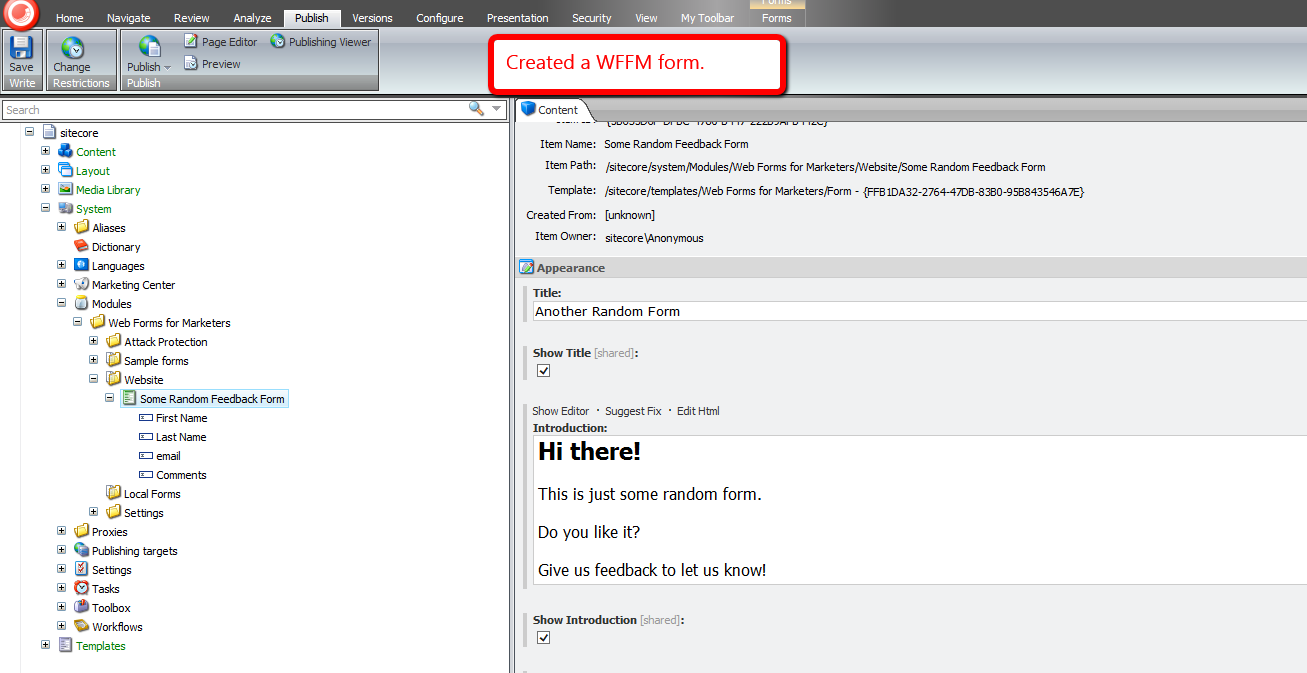
I then mapped the above form to a new page in Sitecore, and published both the form and page.
I navigated to the form page, and filled it out:

After clicking submit, I was given a ‘thank you’ page’:

Let’s see what our field data looks like in the WFFM database:

As you can see, the data is encrypted.
Now, let’s see if the data is also encrypted in the Forms Report for our test form:

As you can see, the end-user would be unaware that any data manipulation is happening under the hood.
If you have any thoughts on this, please leave a comment.
 SitecoreJunkie.com